
By Jacob Richards
It was 2004, our phones were dumb and invasion of Iraq had morphed into an occupation and insurgency, the local anti-war movement active in the run up to war was largely disempowered after the bombs started falling. The lack of dissent was deafening on the campus of then Mesa State College.
Connie Murillo, and I could no longer do nothing. We researched, wrote and laid out a tri-fold pamphlet in MS word, and scored an email that would make Thomas Paine salivate, thepamphleteers@yahoo.com. When classes resumed in January of 2004, The Red Pill was born.
The movie The Matrix was only a few years old, and the term “Red Pill” was not yet the rallying cry of Incels, Anti-vaxxers, and Flat-earthers. The early issues were bad, leaning heavily in shock value in the hope that people would read it even if only out of rage. Yet regular features like “The State of Disunion,” were already taking shape.
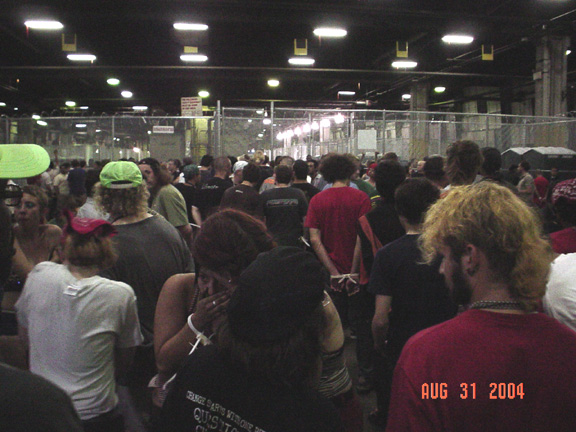
In August of 2004, Connie and I fundraised from supporters to go cover the Republican National Convention protests in NYC and armed with notepads and a donated handy cam we went to cover the action in the streets. On the second day of protests, which was billed by organizers as a day of direct action, the authorities responded heavy handedly, and some 1800+ Americans were arrested in a series of mass arrests. Around 9pm Connie and I were caught up in one of these dragnets. We were then loaded on a bus and taken to Pier 57 on the Hudson River. The pier had long housed a secret unused Department of Homeland security detention center, designed for just such a mass arrest scenario.
Somehow Connie got a small Coolpix digital camera past security and into the secret federal prison. Our journalism had just started apparently. We snapped into action and began covertly documenting our surroundings and the people caught up in this mass violation of 1st amendment rights.
After almost 48 hours in jail, we were finally released. The cops found the camera on me, but not the chip on her. We had missed our plane home while in jail and now had to buy last minute plane tickets home. The next morning our goal was to sell the photos and our story to all the media until we had enough money to get home.
We sold pics to the New York Times, FOX, MSNBC, CNN, The Village Voice, and the New York Post. We sold pictures to all of them, and they largely never aired, but at least we had the cash to get home.
We made it back to Grand Junction, sleep-deprived, further disillusioned with the mainstream corporate media. We were both behind at school and work, The Red Pill slipped out of print. We didn’t even publish our experiences in NYC.
But we were having meetings with co-conspirators. We were screening documentaries that were critical of the corporate media. We even formed a student group on campus—Grand Junction Alternative Media. The idea was always to become bigger than a single publication. We sought to create our own alternative media network.
In January 2005, a new and improved The Red Pill, was laid out, by someone with some real graphic design skills, and their template would be followed, though sometimes subverted, for the next five years.
The Red Pill relaunch was much more collaborative and the people submitted. The anonymity allowed professors, office holders, strippers, activists, soldiers, prisoners, unhoused people and trans-folx to write and share their narratives, evidence, and/or pictures without fear or repercussions for using their voice.
We printed photos by dissident soldiers in Iraq, we printed pictures of improperly stored nuclear waste at the Cheney Cell just 18 miles south of Grand Junction, and never gave up the activists that had to trespass to get the truth.
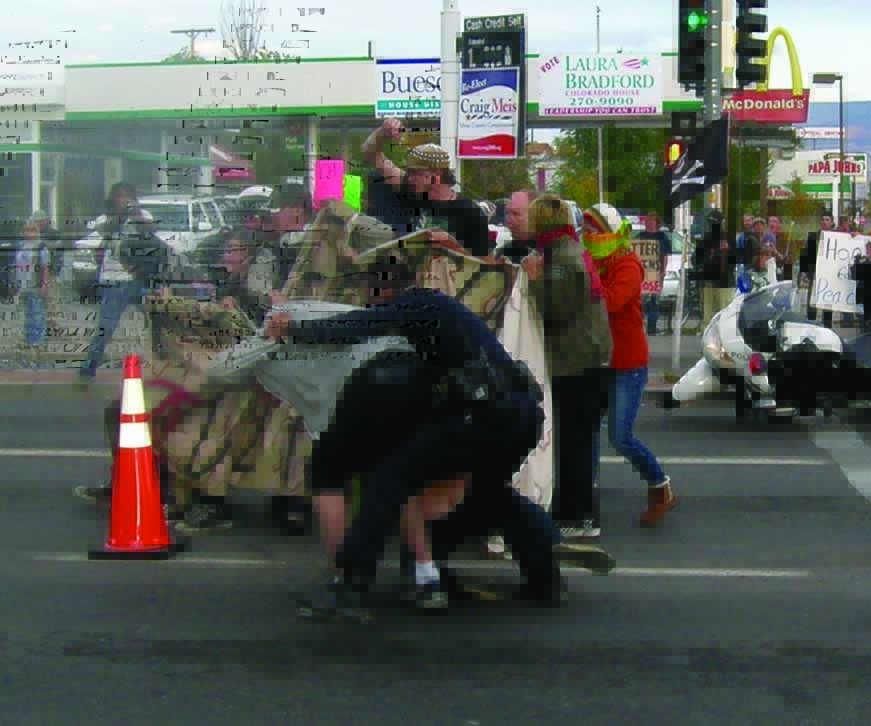
We covered local protest movements. From Anti-War to Immigration Reform, and for Housing First! Our writers reported back from protests in DC, Germany, Denver, Mexico, Phoenix, and anarcho mutual aid efforts in a post-Katrina New Orleans.
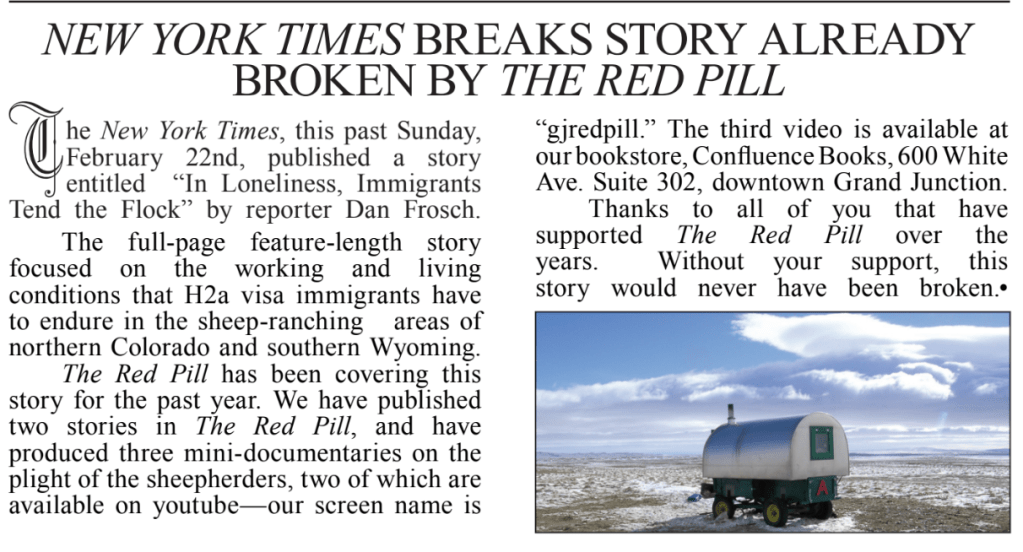
We broke stories. The biggest was broken by Jake Carpenter, and then professor Tom Acker and their work to document labor and human rights abuses of H2A visa immigrant sheep herders. Carpenter would go on to publish three short documentaries on the subject, numerous articles for the Red Pill, and an award winning article in The Denver Voice, Acker and Carpenter also led other, larger media outlets out there to see for themselves.
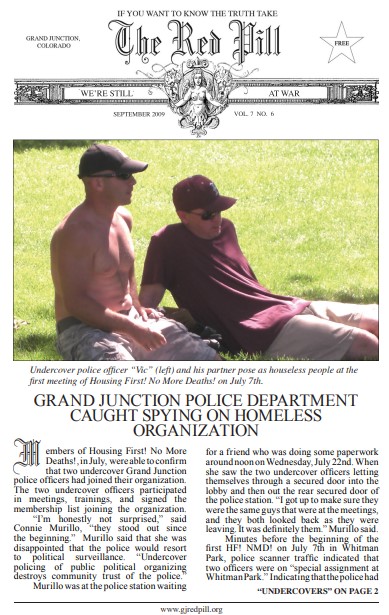
We held the GJPD accountable, and eventually got something like justice. We outed their undercovers as they tried to infiltrate the activist group Housing First! No Deaths! We printed Know Your Rights pamphlets and led Know Your Rights trainings. We ran the blog https://gjpdexposed.wordpress.com/ just to compile all the mainstream and Red Pill articles into one place. We questioned the clear contradictions in the police killing of Brent Ingram, questions that still haven’t been answered. In May of 2010, we investigated unhoused people’s claims that the GJPD had come to their camp and slashed tents and bicycle tires and pissed on peoples sleeping bags and smashed their food with batons. As community media we didn’t remain impotently neutral, we helped victims file the complaints that would see three officers fired.
In November 2008, GJAM morphed into the Confluence Media Collective and we opened Confluence Books. We had an office, a venue and a radical bookstore all in one. We began publishing books and stand-alone zines at a furious rate. The plucky little pamphlet had become the intersection of multiple radical grassroots movements in the Grand Valley.
We had some points of high drama: April 2009, The Daily Sentinel threatened to sue us, for using their photos, in a way that was clearly ‘fair use.’ Their photos of a wild-fire on the island occupied by dozens of people experiencing homelessness contradicted both the official story and their own reporting.
The FBI followed us around for a bit in 2010 after publishing the addresses of the secret unmarked ICE detention center in Grand Junction, as well as the info for centers through the rest of Colorado and Wyoming.
We got leaks from inside the GJPD for years that they were profiling numerous local youth activists as the “The Red Pill Crew.” Tracking IP addresses on our website it was clear that GJPD spent an excessive amount of time on our site. What was the scale of the spying? we will never know. But when I moved away from Grand Junction in January of 2012, I got a call from the Deputy Chief of Police asking: “is it true you’re moving,” a full week before I was slated to leave town.
We took the time to honor our dead, publishing obituaries for persons experiencing homelessness and fellow activists.
But we also had fun, publishing a parody ‘Blue Pill’ each April. We made space for photo-essays, poetry and flash fiction.
The Red Pill went out of print at the end of 2010, and I have always wondered if it was worth it. A recent conversation with Greta Ladson reminded me that it was.
“I was mostly confused about the Iraq War during its start, as I was an early teen.” said Greta Ladson. “Here was TRP and it had all of this information that was so staunchly opposite of the narrative being pushed by the … mainstream.” Ladson said.
Greta received her first copy from her mom who was a non-traditional student at Mesa State College. Her mom said ““you might enjoy this,” tossing Greta a copy. Ladson said “it was something I had never seen before. Not just the format but the content.” Ladson credits TRP for connecting her with alternative media like Microcosm Publishing and Crimethic Ex-Workers Collective and with local organizations making change.
“Those with a sacred duty it is to get information to the people, are instead corporate shills trying to lick enough boots to keep them off their necks,” said Ladson. Adding, “anti-corporate media is more important than ever.”

 The Revolutionist