
by Jacob Richards
Carl Gleeser
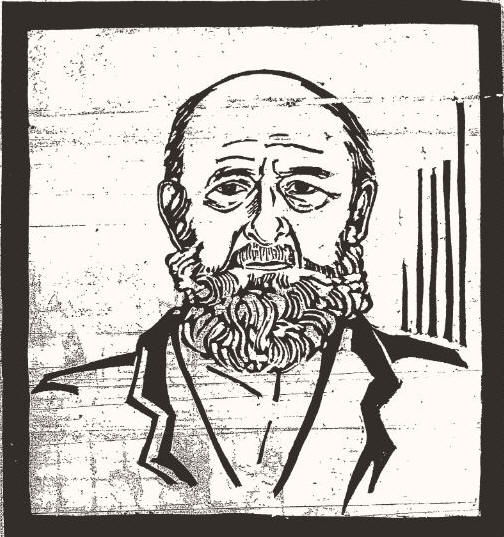
Gleeser was Grand Valley’s first radical and was amongst the first couple dozen settlers in 1881. An anarchist, Gleeser advocated for collective ownership of the first irrigation ditch (he lost), he was an organizer with the Knights of Labor, taking part in Grand Junction’s first railroad strike in 1885, and he helped organized the town’s first library in the Labor Temple
Gleeser was also a distributor of a radical anarcho-feminist newspaper titled Lucifer the Light Bearer. The paper advocated for free love, emancipation of women, birth control and homosexuality, amongst other controversial topics. He was often the top subscription gather in the nation until he left GJ in 1889.
Gleeser would later be incarcerated during World War I for publishing anti-war articles. He spent a year in Leavenworth prison, where the adjacent woodcut was made.
S. B. Hutchinson

S.B. Hutchinson was a lot of things, but he was consistently on the side of the working man and the poor. He knew that solving the issues of poverty and economic exploitation by the capitalist class needed systemic changes, not just charity or ‘thoughts and prayers.’
He was a founding member of the Socialist Labor Party of Mesa County in 1898. He would run for numerous offices, being elected Alderman in 1901, and appointed Chief of Grand Junction Police Department in 1911, a first in the country. He engineered the Grand Junction Scheme which unified the Socialist Labor Party and the Socialist Party.
He was also involved in publishing a number of socialist newspapers between 1901 and 1917, including The Revolutionist.
He was forced to resign as Chief of Police after having the audacity to feed the unhoused with city funds via Walter Walker’s agitation in The Daily Sentinel.
Elizabeth Austin Taylor Morris

Elizabeth was a woman ahead of her time. She was a writer, editor, organizer, minister and mother. Often all at the same time.
Her first husband was the publisher of the first black newspaper in Utah, The Plain Dealer. Many in the small black community in the Grand Valley were subscribers.
She and her husband would make frequent trips to Grand Junction. He came to organize the black Masonic Lodge, while Elizabeth organized the GJ chapter of the Western Association of Negro Women, which held a conference in Salt Lake City in 1904. After the death of her husband in 1907, she became the editor of The Plain Dealer.
Morris and her children moved to Grand Junction in the early 1910s, where she knew people from The Plain Dealer and the WACW. She served as minister at the Handy Chapel for a number of years. She was also a community leader during the rise of the KKK in 1924, and was targeted for it.
Roy Chapman

Roy Chapman grew up in Grand Junction. He was drafted into World War I and subsequently blinded by a mortar shell. Back in the States, he recovered at Helen Keller’s Evergreen School for the Blind. Upon returning to Grand Junction, he operated a bookstore on main street.
A young Dalton Trumbo worked for Chapman walking him to the bookstore in the mornings. Chapman served as the inspiration for Trumbo’s most famous novel, Johnny Got His Gun.
In the 1930s, Chapman was elected to the Colorado State Senate. Likely the first blind member of that body, he was later appointed the first blind director of Colorado’s State Industries for the Blind. In 1951, he was appointed the first head of what became the Colorado Civil Rights Commission. There, he helped repeal Colorado’s miscegenation laws, as well as helping draft a first-in-the-nation fair housing law—for which he was attacked in southern newspapers.
Mary Elizabeth Burns

Mary Burns was one of the early military resisters to the war in Vietnam. In 1968, Mary refused orders and refused to put on her uniform. She was court-martialed and discharged from the military. Her act of refusal made national headlines.
Her twin brother, Timothy, was also resisting by failing to report in for his induction, and was out on bond. On bond, Tim was organizing the earliest anti-war protests that happened in Grand Junction.
Public acts of military refusal and resistance, of which Mary was an early example of, were a major force in ending that bloody conflict.
Larry Burns, Mary’s father, would become an outspoken peace activist locally in the 1980s.
Ray Otero
Ray once walked into the Mesa County Sheriff’s office, took the portrait of the Sheriff off of the lobby’s wall and smashed it. He was promptly arrested.
Was this a senseless act of rebellion? No, Ray just needed to get into the Mesa County jail. Earlier that week, a number of orchardists decided it was cheaper to call Immigration on their workers rather than pay them at the end of the harvest. Ray was on a mission to gather names, employers, home addresses in Mexico, etc. to ensure that the workers at least got paid.
Ray brought the Chicano movement to the Grand Valley. He organizing a student walkout in 1971. He organized the Voz de La Raza community space. He protested the police killings of Jimmy Flores in 1980 and Archie Archuleta in 1993, and sued the school district in Otero v. D51. He and his second wife, Shirley, have been instrumental in securing the community rights to the Sangre de Cristo Land Grant in southern Colorado’s San Luis Valley.
Larry Ruiz
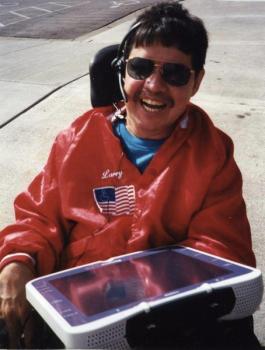
Larry Ruiz was abandoned by his parents at the Grand Junction “State Home” in 1954. Diagnosed with cerebral palsy, he was seemingly doomed to a life of institutions. But Larry was not having any of that. He taught himself how to read and how to write computer code, eventually going on to write code for the first text-to-speech programs.
In 1972, he was transferred to the Heritage House in Lakewood. Three years later, he and other residents escaped with the help of activist Wade Blank. They set up The Atlantis Community, one of the first independent living communities in the nation.
In 1978, Larry and 17 other people blockaded a Denver bus demanding accessibility. Dubbed the “Gang of 18,” the group became ADAPT. According to his obituary Larry was arrested over 60 times in acts of civil-disobedience around the nation in the fight for the Americans with Disabilities Act.
The Revolutionist is 100% Volunteer run and subscriber funded. We do not sell our soul for advertising dollars. Nor do we prostrate ourselves for grants from the non-profit industrial complex. We are community media. Join the community! Subscribe today at whatever rate you can, and get a hard copy of The Revolutionist! in your mailbox. Subscribing subsidizes free distribution copies.


 The Revolutionist