
by Joseph D. Clark
Line up and knock them down. The neo-liberal I was thrust into this world against my will in the year of our lord, circa 1987, and it happens to be that I was raised as a Methodist. The United Methodist Church was founded by a guy named John Wesley, an Anglican Preacher whose motto was, “Do no harm, do all the good you can, and stay in love with God.” By and large, in the United States the UMC is a pretty forward-thinking organization, and our little Jesus bubble in western Colorado was the Christian Kumbaya cocoon for our small, rural community. Sometimes I quite miss that carefree naivety of my childhood.
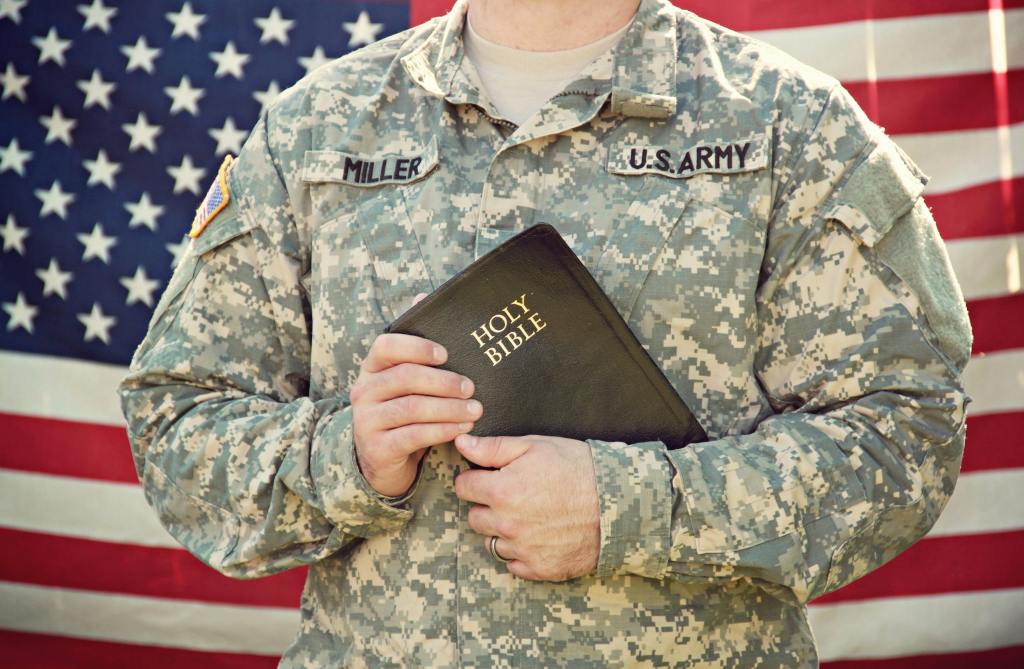
It is because of my somewhat sheltered religious upbringing that the rise of Cristian nationalism in the United States caught me a bit off guard. I suppose that’s how it goes for a straight, white, cis dude in America; oppression feels less intense for those of us with privilege. Being caught off guard notwithstanding, the rise of Christian nationalism isn’t shocking if one considers the convergence of white Evangelicalism and the Republican party. Republicans have been cozying up to Christian extremists since the late 1970s, before the Reagan presidency. But Christian extremists have been cozying up to government for centuries, and continue to cozy up, they shall. The combination of the rise of Christian nationalism and the ambiguity of neo-conservative Evangelical doctrine is making for some insidious theology. In fact, orthodoxy in American Christianity seems to be waning and making way for a fear-mongering war cry, aiming to snuff out anything that fails to champion white Republican Jesus. What I’m saying is that Christians are just making shit up about their religion that suits their personal and political agendas. There are three particularly unfounded positions that American Christians are taking that I’d like to discuss in this piece.
The first position is that the U.S. is a Christian nation, and while the majority of Americans identify with some form of Christianity, this simply isn’t true. The United States was founded as a secular nation—our constitution guarantees that. The first amendment of the U.S. constitution reads: “Congress shall make no law respecting an establishment of religion, or prohibiting the free exercise thereof; or abridging the freedom of speech, or of the press; or the right of the people peaceably to assemble, and to petition the Government for a redress of grievances.” The italicized, underlined section of the text is described as the “Establishment Clause,” and supports the point I’m attempting to make when understood properly. The Establishment Clause is a limitation placed upon the United States Congress preventing it from passing legislation establishing an official religion, and by interpretation making it illegal for the government to promote theocracy or promote a specific religion with taxes. In my view, there’s no honest way to read the first amendment without it condemning Christian nationalism and debunking the idea that America was founded as a Christian nation.
I’ll be the first to admit that it was Christians who conquered North America and subjugated the indigenous populations that were already here, but the United States constitution was designed to prevent any religious group from controlling the government—as I previously illustrated.
Organizations like the Moral Majority and Counsel for National Policy have aimed to destroy that protection in more recent history, and religious leaders across the United States today are committed to promoting Christian nationalism at the expense of democracy. Furthermore, many of these religious leaders explicitly purport the falsehood that the U.S. was founded as a Christian nation—and their followers really believe them. In fact, it’s impossible to convince many of them otherwise, even when presented with sufficient evidence. They know that they know that they know, and they’ll tell you so with unbridled confidence, Dunning-Kruger effect be goddamned.

The second position is regarding the nation of Israel, and at the risk of being labeled antisemitic, I’d like to express my humble opinion about the issue as clearly and concisely as I can. The nation of Israel today is not the same as Israel in the Bible, although many people would like to think they are exactly the same. I believe many people support modern Israel because of this misconception, and I don’t think it’s reaching to suggest that those who formed the current state of Israel may have done so to encourage the manifestation of a certain interpretation of the Bible—specifically the book of Revelation. In my opinion, this generates an overwhelming and unbridled support from the Christian right for any of Israel’s actions in the world. If Israel is chosen by God, then everyone else is fucked. At least, that’s how it always goes in the Bible. How much sense does it really make to base foreign policy on an ancient Mesopotamian mythology whose authenticity we can never know for sure? Some will argue for the historical reliability of the Bible, but these arguments most often come from people with a vested interest in it being true: people who have for generations structured their whole lives according to Pascal’s pathetic wager. I would prefer to be governed by people who respect our current and verifiable model of understanding of the world, not by superstitious fear-mongers who want to burden humanity with a cosmic guilt-trip.
The third position definitely flows from the second—that is, Christianity’s obsession with the End Times. There are too many end times conspiracy theories to count, but they mostly have one thing in common: God’s going to save Christians, take them to somewhere else, and everyone else will burn for all eternity. I feel like that’s a little harsh, but the god of the Bible is pretty brutal. Regardless, the point is that…well, what’s the point if we’re going somewhere else and this world can just burn? Why make this life better if the afterlife is the one we really want? If all that is true, then I agree that there is no point. However, I really don’t think there’s any good reason to believe the Bible is true, or that Christian nationalists can be trusted. Personally, I plan to make this one life on this one Earth as good as I can possibly make it. And call me crazy, but I don’t think it’s good for our lawmakers, city council members, and school board members to be a bunch of religious extremists who think the world is going to end soon. People like that aren’t working for a better today; they’re obsessed with some heavenly tomorrow.
One of my hobbies is arguing with Christians on Facebook, but I don’t just barge in guns ’a blazing in the comments. I like to find someone who wants to have a serious conversation, I message them privately, and I’ve been pleasantly surprised by the level of civility I’ve received. However, I can’t help but remark on how confident people can be in their position and also be completely incapable of telling me how they know it to be rational. They just believe it because it feels like it’s true, or they receive direct revelation from God. They believe in this other kind of knowing things, mostly things we have zero evidence for. So, I ask them simple and pointed questions and usually we can come to some common ground, though I’ve never had anyone up and change their position—not even once. But I have helped people find holes in their arguments, see their own intellectual blind spots, and I’ve found some of my own. I support having conversations with people we disagree with, as long as all parties involved are being respectful. After all, how will we learn if we allow ourselves to be stuck in an echo chamber? Religious extremism is dangerous; there’s no two ways around that. As Americans, we likely automatically think of Islam when we hear that term, but religious extremism in America wears a Jesus costume. A large portion of the U.S. population believe we are a Christian nation—which is patently false. Many of these Christians give their unbridled support to Israel, human rights be damned. And swaths of them are supporting terrible policies out of a genuine belief that the world is about to end—who cares, if they’ll all be raptured anyway? I’m no longer a Methodist. I don’t subscribe to any particular religion. I would consider myself an atheist now, but for a long time, I thought I would become a pastor. I’ve studied the Bible pretty extensively, and that’s why I don’t believe anymore. But I think it’s great that people get to decide for themselves what they believe and what their values will be in respect to how they live. That’s the kind of freedom that we’re supposed to have in the United States. That’s why I also support complete separation of religion and government—no exceptions—because that’s the only way to protect religious freedom.
The Revolutionist is 100% volunteer run and subscriber funded. We do not sell our soul for advertising dollars. Nor do we prostrate ourselves for grants from the non-profit industrial complex. We are community media. Join the community! Subscribe today at whatever rate you can and get a hard copy of The Revolutionist in your mailbox. Subscribing subsidizes free distribution copies.


 The Revolutionist