
by Kailey Goode
Since the 1950s and the advent of the automobile, suburbs have been the primary form of new residential development in America: expanses of twisting roads, large houses lined up like products, and big-box stores surrounded by lakes of parking. On the surface, suburbs seem like a perfect solution to housing, a great place to raise children and live out the American dream. The truth is this way of building isolates people from their community. Suburbia, and the car dependency implicit in it, segregates us and creates an environment hostile to the organizing of the working class. Like all things, the suburbs and its cars are made by and for capitalism.
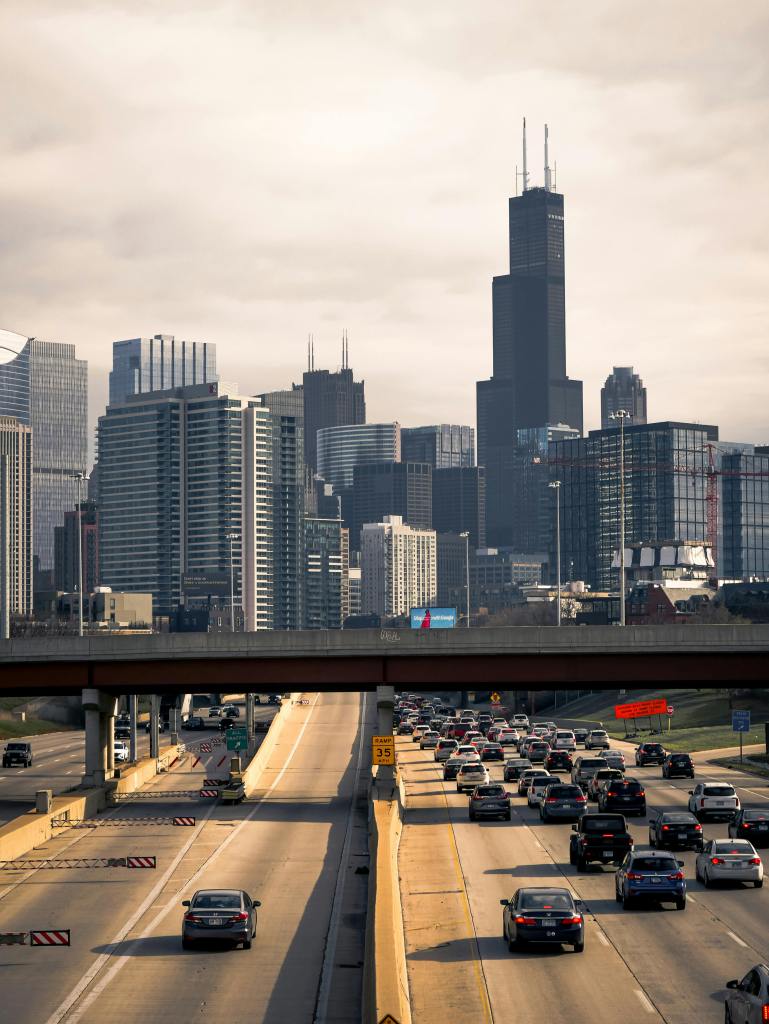
Despite its prevalence, the suburban method of development has garnered critique across political divides. The fast roads and sprawling housing brings disadvantages that anyone can object to. Cars themselves are very expensive to buy, fuel, maintain, and insure. Yet suburbia essentially requires that a family has multiple vehicles. This is because the road design and land use of suburbia is built solely with cars in mind. The required parking of everyone’s cars further space out homes and businesses. The result is that shops, work, and home are often out of walking or biking distance. In fact, walking or biking can be dangerous next to fast-moving vehicles. The danger of everyone driving also increases the severity and frequency of car crashes, leading to an arms race of sorts as everyone seeks to buy bigger, “safer” vehicles. These feedback loops lead to more traffic, requiring more lanes, more road maintenance, and more sprawl. The headaches of car dependency are expensive, dangerous, and inconvenient for everyone, not to mention unsustainable in the face of climate change.
The history of suburbia is also rife with social issues. New constructions of large highways and housing developments deepened racial segregation and class divides. New highways were almost always built through black and brown communities, displacing thousands of families. Meanwhile, the wealthier white populations of cities escaped to red-lined neighborhoods and newly built homes. Wide roads, confusing layouts, and lots of fences have created two classes of communities: racially diverse, poor communities and predominantly white, wealthy communities. This all continues today through the continued construction of wider highways and newer, fancier developments with more gates and security. Through structural violence and hostile urban design, the end result is people are disconnected from their community.
Both the physical geography and transportation of the suburbs literally separates us from our neighbors. The large houses and fences create boundaries between family units, and cars insulate us from anyone outside the moment we leave. This recreates a very individualistic culture. More public forms of travel like transit, biking, or even walking are often not even considered options, so drivers are often flagrantly unconcerned with their surroundings. This disregard for safety leads to dangerous driving and speeding. More broadly, these divisions normalize a neglect for your fellow humans and the environment.
All of the problems with car dependency are kept alive by the massive corporations that it benefits. Most obviously, the requirement to drive forces residents into car ownership. And the constant driving leads to more wear and the need to buy new cars (if you can afford it) or risk the inconvenience and danger of breaking down. Of course, all of this driving burns literally billions of barrels of gasoline every year. The need to drive to go to work or get food also makes gasoline a largely inelastic demand. In fact, gas prices have influenced elections, and incentivizes opposition to environmentalist policies that could make gas more expensive. This is how car culture exacerbates class divides and feeds into anti-environmentalism.
A large system of powerful institutions maintains the culture and structure of suburbia. The massive auto manufactures, oil and gas companies, and real estate developers rule the stage. However, they are also allied with “homeowners associations” (HOAs) and the prevalence of “not in my backyard” attitudes (NIMBYism). These groups often oppose projects like constructing multi-family homes, apartments, and mixed-use buildings needed to make a community more affordable and walkable. They profit from opposing policies which could make our communities more diverse, prosperous, sustainable, safe, and convenient.
A solution to the issues with car dependency and suburbia may be found in the rapidly growing ‘urbanist’ movement. Urbanism generally advocates for denser housing, and investment in public transit, as well as making cities more walkable and bikeable. Even conservatives love the possible money saved on personal vehicles and road maintenance as a taxpayer. Parents can find peace with safer roads while their kids don’t always need a car to get to school, activities, and friends’ houses. Urbanists also try to emphasize a healing of past mistakes by reconnecting marginalized communities as well as making accessible infrastructure for those with disabilities.
Examples of good urbanism can be found globally. Cities like Amsterdam, Tokyo, and New York City have long been celebrated for their dense neighborhoods and high quality transportation. Amsterdam in particular has been pushing out cars in favor of biking infrastructure across the city. When biking becomes the most popular form of travel, it is easy to go to school, work, shops, and home within a 15 minute ride. This creates a quieter, cleaner, safer, and healthier city.

However, you don’t need to be in New York to have good urbanism. Cities of all sizes are becoming more urbanist. New housing is needed everywhere, however instead of big family homes or highrise apartments, cities can build medium-density housing like townhomes, multiplexes, and row-housing. New buildings can also be built closer together when cities repeal parking requirements. Small cities can invest in their bus systems, even creating dedicated lanes so they are actually as fast as driving. Here in Grand Junction, work is being done to create a better biking network, however our bus system is still impractical and slow.
Building communities with urbanist principles can improve the quality of life for its residents and develop a stronger sense of community; however, there are limitations. Urbanism is largely a liberal movement and works within established governments. Yet car dependency is violent. From the deaths caused by collisions and the inequality it creates, as well as the environmental destruction it contributes to, leftists should consider if relying on local policy changes will create change fast enough. A radical view of urbanism could use the labor power of the working class to demand faster change as well as progress to adjacent issues like housing. Urbanism also tends to forget about rural communities. While urbanism is certainly applicable to small towns, a radical approach should consider how the rural/urban divide could be mended. Practices like community and backyard gardening would fit well in urbanism as well as address the environmental issues of industrial agriculture.
Suburbia and car dependency creates a tangle of issues that affect our daily lives. If the working class of the world is meant to organize, urbanism may be an important part of mending broken communities and raising general quality of life. Class consciousness is more likely to spread amongst tightly knit neighbors and people who see each other every day on public transit or out walking. For the sake of our environment and our communities, we have to pay attention to the physical infrastructure that can so easily divide and hurt us. A clean and efficient city is a city on the path to revolution!

 The Revolutionist