

by Jacob Richards
The case of Caroline Dais Goncalves has made headlines across Colorado and the nation and is now headed to court, but the coverage and both lawsuits miss the forest for the trees.
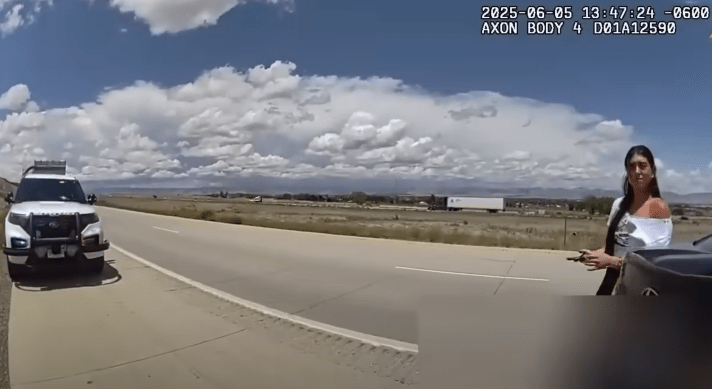
On June 5, Mesa County Sheriff’s Deputy Alex Zwinck, pulled over Goncalves for following too close to a semi-truck, Zwinck in violation of Colorado law then shared her ‘Personally Identifying Information’ (PII) in a Signal group chat administered by Homeland Security Investigations. Zwinck released her with a warning. A few minutes later Goncalves was pulled over and arrested by HSI and transported to ICE detention.
SB25-276, A recent Colorado law, forbids local and state agencies from sharing PII for immigration enforcement.
Investigations were launched.
On July 22, Colorado Attorney General filed suit against Zwinck. A week later, Mesa County Sheriff Todd Rowell released the findings of his department’s administrative review and issued a statement in which two deputies and three supervisors were disciplined. The next week Mesa County in turn filed a lawsuit against Governor Polis and the Attorney General, essentially for the right of officers to ignore Colorado law and do the Fed’s work for them.
Sheriff Rowell and the Mesa County Commissioners are also crying foul, claiming Zwinck and Mesa County had been unfairly singled out for the purposes of political grandstanding by the AG.
“I ask that Attorney General Weiser apply the law equally to all law enforcement and government officials,” said Rowell in a statement.
He is not wrong, and the materials he released paint a picture of widespread disregard for Colorado law both within his department and across western Colorado, but they also show why Zwinck was targeted.
Zwinck was going above and beyond. An HSI agent praised his efforts in the chat. “Zwinck is gonna get ERO [Enforcement and Removal Operations] interdictor of the year.”
After Zwinck’s intelligence netted yet another immigration arrest, he messaged the group chat, “Oh my gosh. We better get some bitchin’ Christmas baskets from you guys.”
The “we” is key, because Zwinck was not acting alone. MCSO Deputy Erik Olsen also shared people’s identifying information with the purposes of immigration enforcement. Olsen told investigators that he had been on the scene for dozens of immigration enforcement arrests.
Zwinck then resigned, seeking greener pastures and AG Weiser dropped the lawsuit against him. Mesa County has vowed to move forward with their lawsuit.
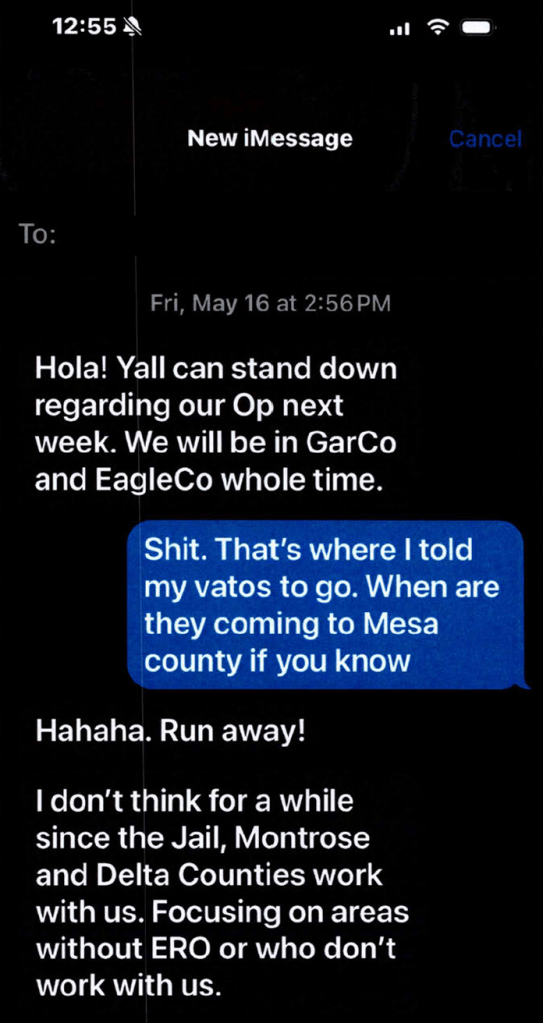
Buried in investigative documents, a text message thread from Eric Selfridge acting Resident Agent in Charge of HSI, to MCSO Lieutenant David Holdren in which Selfridge tells Holdren that HSI and ICE would not be returning to Mesa County “for a while since the Jail, Montrose and Delta Counties work with us. Focusing on areas without ERO or who don’t work with us.”
The jail is working for ICE? Seems like a big systemic failure of Colorado law that needs to be investigated.
Additionally, Sheriff Rowell’s statement accuses a Colorado State Patrol trooper by name, and hints that other agencies are sharing PII. Additionally Rowell points out that the Governor has violated the same law by handing over PII to ICE/HSI on four occasions, according to reporting by the Denver Post.
Something that has not been touched on is why were the deputies sharing PII in a chat group.
Local law enforcement were sending PII to the Signal chat for a very specific reason, one discussed at length in the interviews with Zwinck’s supervisors.
Zwink and others were sharing this information so federal agents could run it through a national database called: DICE.
The way this worked in the “Highway Hitters” Signal Chat, is that the local officer would send a suspect’s PII to the group chat, then the feds would run the info through the database, and then relay the results back.
DICE data includes immigration status, as well as any known ties to criminal organizations or ongoing investigations, border-crossings, and ‘hits’ on Automatic License Plate Reading cameras around the country.
HSI is thoroughly embedded into regional multi-jurisdictional taskforces across the state, and is likely running PII through DICE for your local officers, leaving them open to violations of SB 25-276.
Furthermore, these task forces often operate with little to no oversight. Zwinck’s supervisors didn’t know about the Signal chat, and only learned about the DICE database after the investigation had been launched. Leadership within the MCSO didn’t inform officers about SB25-276 that went into effect in late May. Though they repeatedly reference an earlier email from February about immigration enforcement.
Another grey zone where local law enforcement knowingly and often unknowingly share PII with immigration enforcement, is through the omnipresent networks of Automatic License Plate Reader cameras.
The Rev, obtained documents via an open records request, that show that during the 39 minutes from when Goncalves was first stopped by Zwinck, through her release, and subsequent arrest by HSI, Grand Junction Police Department ALPR cameras were accessed five times by two Garfield County Sheriff deputies.
One of those deputies, Nate Lagiglia, has recently come under-fire for helping HSI arrest and transport Luis Armando Rivas, on June 3. Rivas was arrested in Glenwood Springs and then driven to the rear of the gas station in De Beque and transferred into an ICE vehicle.
Lagiglia is a Task Force Officer with SPEAR, an inter-agency taskforce, like the Western Slope Drug Task Force which Zwinck was working for when he pulled over Goncalves.
Denver Police were recently surprised to learn that their Flock Safety ALPR cameras had been accessed 1400 times by agencies around the nation for purposes of immigration enforcement, before they restricted the data sharing functions of the system.
Around Colorado and the nation, immigration enforcement continues to find side-door access to ALPR data though friendly agencies and officers. (Just like local task force officers are gaining side-door access to the DICE database.)
SB 25-276, a seemingly simple law, has some very complicated implications, and local departments are forced to navigate an ever changing high-tech landscape with no guidance from the state.
“Clarity” was one of the reasons that the Mesa County Board of County Commissioners gave for moving forward with the lawsuit against the AG and Governor Polis.
And clarity is needed.
Local law enforcement needs guidelines on how to participate in multi-agency task forces that include federal agencies engaged in immigration enforcement.
They need guidance on how to deploy ALRP camera systems in a way that ensures PII collected isn’t used for immigration enforcement.
They need guidance on the use of and supervision of chat groups within inter-agency taskforces.
Colorado and federal law can be in conflict and co-exist.
We do it every day, as dispensaries regularly sell what the Feds consider a schedule III narcotic.
We do that through accountability and guidance from the state.
One thing is for sure without guidance and accountability, Homeland Security is going to be on the hook for a lot of bitchin’ baskets across Colorado come Christmas.
###
The Revolutionist is 100% volunteer run and subscriber funded. We do not sell our soul for advertising dollars, nor do we prostrate ourselves for grants from the non-profit industrial complex. We are community media. Join the community! Subscribe today at whatever rate you can, and get a hard copy of The Revolutionist in your mailbox. Subscribing subsidizes free distribution copies.


 The Revolutionist