
By Ky
Penny Arcade, a revolutionary voice of the marginalized, and fixture of the New York City underground performance art scene will take the stage at Lithic Bookstore in Fruita Colorado on September 19 and 20, for two evenings of spoken word.

Arcade has been influencing the course of art and politics through theater, cultural memory projects, and experimental performances for more than fifty years.
Emerging from the Lower East Side avant-garde art scene of the late 1960s, her work is saturated with themes of survival, social justice, erasure of outsider voices, LBTQ liberation, gentrification, community and resistance.
Informed by her working class roots, Arcade embraces working class values and cultural diversity. Born in 1950, as Susana Carmen Ventura, to immigrant parents, Arcade spent her childhood in New England.
Childhood was brief for Arcade as she learned to survive on the streets as a runaway youth, eventually finding her way into queer clubs in New Britain, Connecticut. This was where she first encountered the growing queer counter-culture, and she wanted more, but it would have to wait.
During a brief stint in reform school at the age of 14, she was prompted to write her first play by one of the Catholic nuns.
After returning to the streets, Arcade was encouraged to make her way to New York City, specifically the Lower East Side (LES), by the drag queens she befriended on her travels as a runaway.

When she was 17 arrived in the LES, and found belonging among society’s exiles and misfits gathered in the Lower East Side.
She soon met photographer Jamie Andrews, who provided the young artist refuge in his queer space and became her first mentor. Andrews helped in the creation of her new persona, “Penny Arcade,” during an acid trip the two took together.
Andrews introduced Arcade to John Vaccaro, founder of The Playhouse of the Ridiculous, an avant-garde, experimental theater troupe. She soon started performing with The Playhouse, and began a fifty year career on the cutting edge of performance art. She began meeting larger than life avant-guard characters such as drag performer, playwright, and Warhol superstar Jackie Curtis.
Arcade came to the attention of Andy Warhol during her early performances with Vaccaro and The Playhouse, and she was recruited as one of Warhol’s “superstars,” a recognized position in his posse of artists.
Through this Warhol gateway, Arcade networked in the NYC underground art scene, rubbing shoulders with Warhol superstars such as Candy Darling and Holly Woodlawn, both pioneer transgender actresses and muses to Lou Reed.
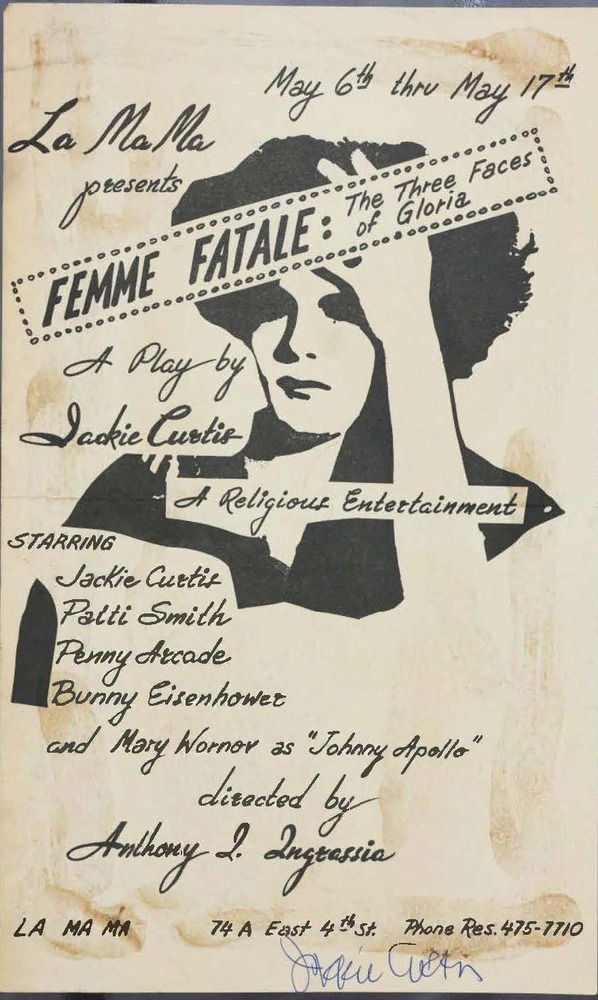
Arcade was featured in Jackie Curtis’s own theatre production, Femme Fatale: The Three Faces of Gloria (1970) along with punk icons, Patti Smith & Jayne County.
Arcade made her film debut in Warhol’s film, Women in Revolt (1971) along with Curtis, Darling and Woodlawn.

She soon left the Warhol scene, returning to The Playhouse of the Ridiculous now based in Amsterdam and Spain. All while protesting the police state and the Vietnam War.
While recognizing Warhol’s contribution to her career, Arcade critiques his aloof, monetized and ego-driven art. Arcade noted that Warhol was more interested in his fame than creating art which reflected the marginalized populations he surrounded himself with.
Conversely, Arcade deliberately rejected celebrity and commercialization, focusing instead on political engagement, queer visibility, and cultural preservation.
Arcade has stated her queer identity was never isolated to just her sexual identity. It encompasses her lived political stances, informing her commitment to women’s rights, civil rights and LGBTQ+ liberation. Arcade practiced sex-positivity, intersectional feminism, and queer identity by embodying them, prior to the term “queer theory” entering the academic lexicon.
Her unique style of performance includes stand-up comedy, striptease, political declamation, monologues and memoirs meshed into improv, and interactive performances.
Arcade has written and performed 16 original full length plays, with Bitch! Dyke! Faghag! Whore! Being the most well known. Each performance was site-specific, and included storytelling, striptease, comedy, queer themes and biting social critique.
BDFW explored themes of censorship, slut-shaming, homophobia, and the policing of identity.
The confrontational title, intended to reclaim slurs and marginalized identities, forced her audiences to examine their discomfort and was an act of resistance. BDFW brought attention to attacks on queer expression and examined the human toll of the AIDS crisis. BDFW influenced later feminist and queer performance artists to blend comedy, sex, and activism, while cementing her as an iconic feminist, queer, and sex-positive performance artist.
Arcade often pays homage to cultural figures who influenced her artistic journey, like author and self-described “stately homo of England”, Quentin Crisp. Crisp became a “queer elder,” and even a role model to Arcade over their decades long friendship. Crisp encouraged Penny to use her honesty and humor unapologetically.
Arcade and Crisp even shared the stage in, The Last Will and Testament of Quentin Crisp (1992), combining their biographies, comedy, and cabaret. The British film depicting the last two decades of Crisp’s life, The English Man in New York (2009) included Arcade, depicted by actress Cynthia Nixon.

Judith Malina was another guiding force in Arcade’s career. Malina was the writer, performer, and co-founder of The Living Theatre. Malina saw theatre as a political tool for empowerment and revolution, and her vision transformed both performance art and Arcade.
Architect and videographer, Steve Zehentner, is another lifetime collaborator with Arcade. The two collaborated on multiple shows together over the course of decades. Zehentner’s support was vital to Penny’s art, allowing her to maintain independence from corporate production companies–freeing Arcade to remain true to her activism and art.
Arcade and Zehenter’s Lower East Side Biography Project (1999) collected oral histories with artists and cultural figures from New York City’s art scene and counter culture. Focusing on people who have been largely erased by gentrification and the fine art establishment.
Arcade coined the term “cultural amnesia,” referring to the loss of wisdom, values, and traditions of elders whose efforts created movements and culture that we now build upon today. Arcade focuses on her community in the Lower East Side, which serves as a case study in cultural amnesia.

Her activism has focused on helping communities organize locally against displacement. In a 2018 interview with Oregon Arts Watch, Arcade pointed out that she’d fought for housing rights for years with little impact because the public typically doesn’t mobilize until they are personally affected.
She encourages young artists and community activists to focus on local organizing. She stresses the importance of fighting for affordable housing, rent reform and demanding large corporations pay taxes and do not receive public handouts.
Arcade has numerous critiques of the professionalized art world of theory, academia, museums and big name galleries. Arcade considers these institutions “engines of gentrification.“ Arcade shines a bright light on the role art institutions play in minimizing radical politics, while commodifying rebellion, and calling them out for artistic gatekeeping .
Arcade never sought approval from institutions. She thinks academic art discourse is elitist and exclusionary, validating only “official” artists. Arcade is proof that underground art movements created powerful works outside of these systems, but history often gets rewritten by the gatekeepers of ‘fine art.’
Arcade advocates for inclusive, underground spaces where art can be rooted in memory, body, truth-telling and community. Penny emphasizes “art as a vocation, not a career.”
She stated in an interview with the podcast Making Better, “I don’t believe you can change the world, but I do believe you can change the world around yourself. I have always been anarchic. As Judith Molina once said to me, ‘Penny, you’re an optimist, because you’re an anarchist, and all anarchists are optimists.’”
Arcade sees revolution not in overthrowing the entire system over in one sweep, but as creating liberated spaces in the cracks of capitalism’s oppressive facade–until it crumbles.
Penny Arcade’s influence extends far beyond her performances. She’s a radical historian, underground mentor, and cultural queer icon. Her work is more relevant and even urgent today, as we resist cultural erasure and reclaiming our community power.
For those committed to independent, queer, and/or radical art, culture, and social change, Penny Arcade’s upcoming performances at Lithic Books are events not to be missed.
Event info: https://www.facebook.com/events/800187789124115
###
The Revolutionist is 100% volunteer run and subscriber funded. We do not sell our soul for advertising dollars, nor do we prostrate ourselves for grants from the non-profit industrial complex. We are community media. Join the community! Subscribe today at whatever rate you can, and get a hard copy of The Revolutionist in your mailbox. Subscribing subsidizes free distribution copies.


 The Revolutionist