

There is far too much smoke and mirrors when it comes to community organizing. Too many highly educated organizers hiding behind buzzwords and technical jargon. Maybe they enjoy the mystique as the wizards of movements. I don’t know. I just want to share some lessons learned the hard way, and some ideas I have on the subject kicking around by brain.
I spent my youth being dragged to protests and meetings by my mom. When I was ten, she ran and was elected to local office, I licked envelopes, labeled mailers, and knocked doors for candidates and issues throughout my early teens. I was born into you could say. In the 2000s I cut my teeth organizing against the wars in Iraq and Afghanistan, I co-founded The Red Pill, an activist publication that ran from 2004-2010. Later I co-founded Housing First! No More Deaths! And organized with the unhoused to find grassroots solutions. In 2020, I again became involved in my community when I organized Grand Junction Mutual Aid in 2020 in the face of the Covid 19 pandemic.
Most of my organizing and activist experience has been local to Grand Junction, Colorado. GJ is a deeply conservative city twenty miles from the Utah boarder. The metropolitan area has a population of 150,000 people. We are isolated geographically: four hours from Denver and five hours from Salt Lake City. This zine will be most useful to organizers working in rural and conservative communities, but I hope there something here for organizers everywhere.
Jacob Richards
Ecosystems of Change
At its core community organizing is face to face human interactions. This is the atom. The basis from which everything else is built. We must make space and encourage that most fundamental structure. Television ads do not make a movement, as the 2024 election has proven. Screaming into your online echo chamber isn’t ‘doing something,’ as the liberal response to the first Trump presidency illustrated. We must get past that impulse and engage in the real world with each other.
The first anarchist collective in Grand Junction 2005-06 used to host a weekly vegan dinner. There was no overt purpose but to bring people together. We would make announcements about upcoming events and then we would eat. People kept showing up. We broke bread. We talked. Conversations became friendships and audacious plans for changing the world. We became molecules.
Bringing molecules together is something that never stops. At the beginning of events, I am a big fan of encouraging the attendees to stand up and take a few minutes to introduce themselves to three or four people that they don’t already know. This is the glue that holds organizations and movements together. Everything is based and rooted in these basic human relations.
Molecule formation also looks like building and maintaining email lists, phone trees or nowadays stacks or discords servers. Communications can take place online but also need to be solidified in real life. Make accommodations for people. Masks are okay. Kids making noise is okay, organizing child care is better. If you are organizing the unhoused provide food. Lower barriers to bring people together.
Molecules are cool. We live, love and work in molecule sized groupings of human relations. One of the organizer’s jobs is to find a place for molecules in existing organisms/organizations, and form them into new organizations when needed. Rarely does an organizer work on organizing single individuals, that would take too long and take too much effort. Seek to organize molecules of people. You will organize individuals inevitably but view every individual as a potential molecule, as people often bring their friends, family, lovers and communities into the fold. Ask them clearly to reach out to their circle of people for support and new atoms.
A Voice of Reason was the local anti-war group organizing to end the war in Iraq and Afghanistan. It was a strange alliance of molecules: libertarians, peace and justice Catholics, 9/11 Truthers, Greens, Anarchist, progressive Democrats and liberal faith communities. AVOR never formally joined United for Peace and Justice (UFPJ), or Act Now to Stop War and End Racism (ANSWER), the two national anti-war coalitions. Then in March of 2009, Grand Junction was the only community in Colorado to hold a protest and rally on the 6th anniversary of the invasion of Iraq. Obama was now at the reins which placated the anti-war movement nationally, but since we were independent and issue driven we didn’t change our organizing because nothing had changed on the ground in Iraq. We had become an organism strong enough to survive the regime change that killed the larger movement.
A single organization is just that, and if it’s the only organization it will die, just like a solitary organism isn’t long for this planet. Organizations and organisms both need ecosystems to survive. One of the definitions of a political movement is when you have multiple organizations of different persuasion and backgrounds all working towards similar ends.
Ecosystems and movements need oxygen, nutrients, and other organisms populating it. Ecosystems are not always free of internal conflict, and change is a constant, but it is also the setting of mutual aid, symbiosis, solidarity and interdependence.
A movement needs to breathe. The oxygen that movements breathe is space—both physical and intellectual.
The Labor Temple and later labor hall(s) were vital to early Grand Junction’s strong labor movement 1880s-1930s, so too was Quincy’s to the 1979 LGBTQ community when it opened as Western Colorado’s first ‘gay bar.’ Community spaces to hold meetings, movie screenings, trainings, potlucks, game nights etc are essential.
Movements also need intellectual spaces. Movement friendly media is where ideas, dreams, tactics can be debated and talked through. Radio stations, podcasts, newsletters, blogs are all essential.
The twenty year long Socialist movement in Grand Junction almost always published its own weekly newspaper. From 1898 to 1918 local socialist published: The Cause, The Slogan, The Revolutionist, The Enterprise, The Dawn, The Critic, and The New Critic, as well as issue specific ‘circulars.’ Additionally, both socialist parties (yes there were two at one point in dusty Grand Junction), each had their national weeklies; The Appeal to Reason and The Weekly People.
Movements and ecosystems also need nutrients. New people and molecules of people are necessary. A movement that is not growing is dying. Conversely too much growth too quickly can be a cancerous, and the center will not hold.
Money and other resources are also essential nutrients. It’s a fact of life. When you need resources, ask. Ask clearly for what you need. Ask more of those who have more, but ask all your members or supporters to contribute to the movement no matter how impoverished they may be.
In 2009, local anarchist organizers and leaders within the homeless community founded Housing First! No More Deaths! (HF!NMD!) We meet in Whitman Park weekly. Every meeting was run by consensus, we set an agenda and passed a tobacco can, the unhoused members of the group pitched in change and wrinkled dollars. It made the organization their own. And it gave us a modest war chest for inevitable costs. Money is tricky. Housing First! No More Deaths! chose to exist as an unincorporated association, we had no bank account, we had a tobacco can and a paper ledger kept in long hand. It had its limitations, but there are also limitations to 501(c) 3 charitable organizations and other formal structures.
In 2020, a large grant of money tore apart the Right and Wrong (RAW) coalition which formed out of weeks of protest after the police murder of George Floyd. Without getting into the details that ‘organizers’ have continued to keep secret–make a plan for how money and donations will be handled. Make sure there are checks on spending and that a rogue faction or individual can’t take over the organizations finances.
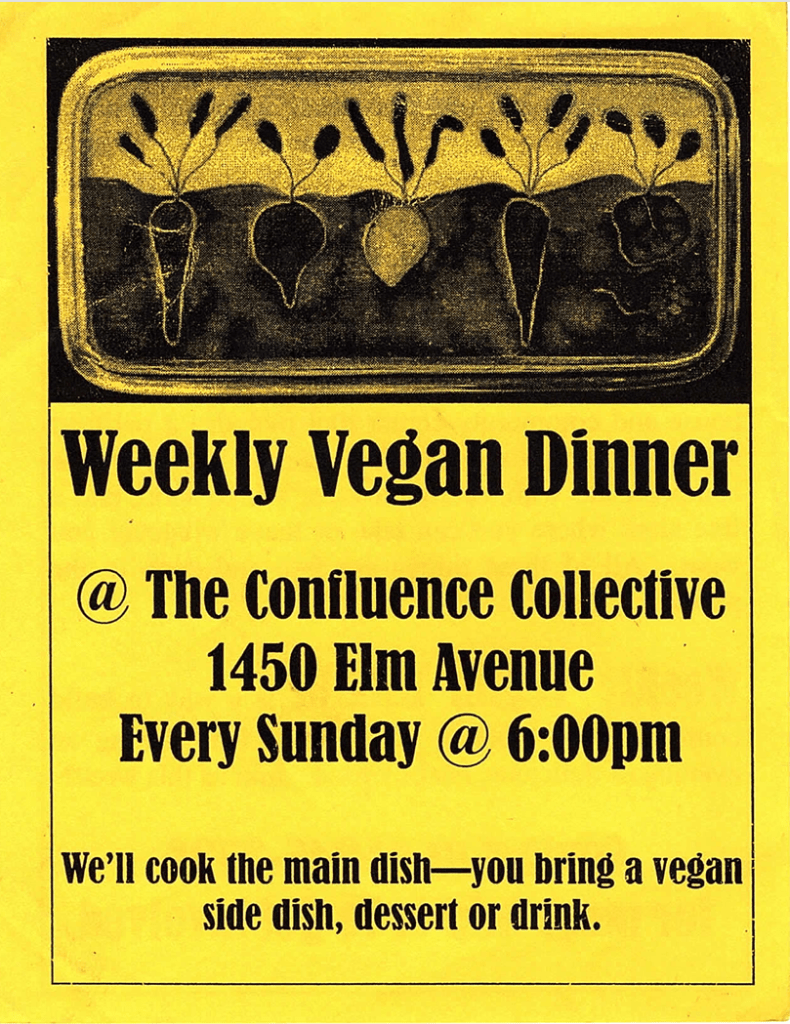
All organisms, molecules, and ecosystems need rest and rejuvenation, and purely social events like the Vegan Dinner at the Confluence Collective is how this is done. Sign making parties before an action are also great bonding opportunities The circle comes, well full circle. Foster atoms, connect them into molecules of people, organize molecules into organisms, and feed your ecosystems. All the steps all of the time.
We are a community first and a movement second!
Other lessons learned Along the Way
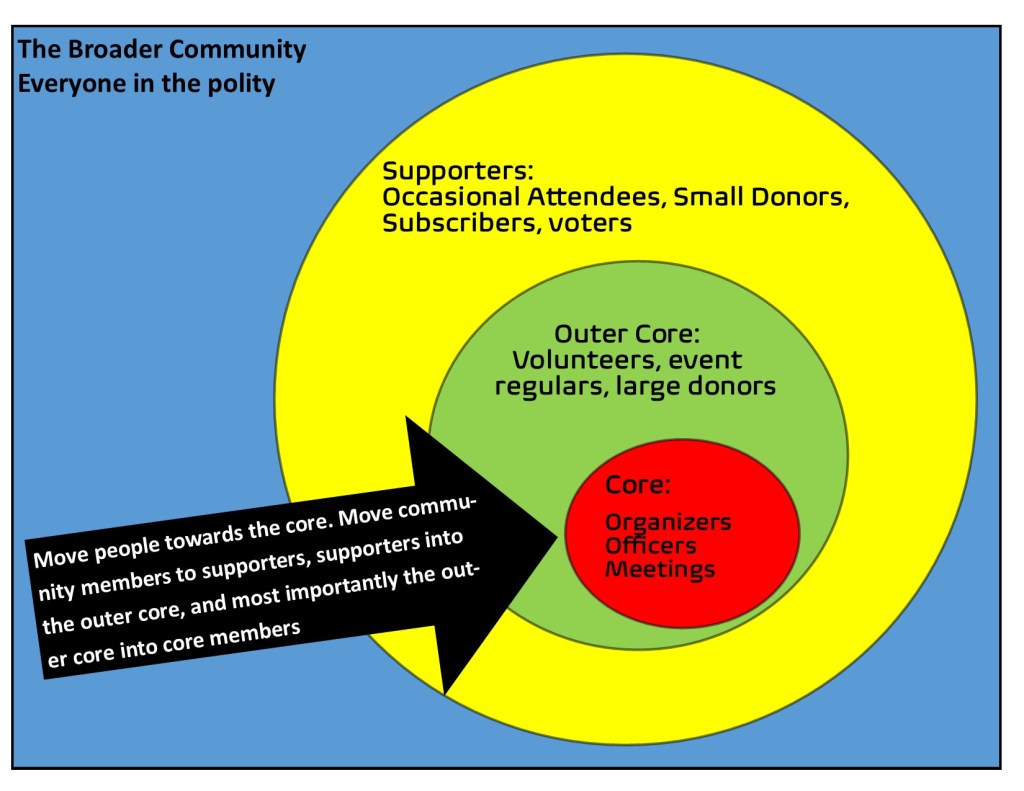
Small is Okay—Small is nimble and communication is easier. The core of any organization is often pretty small. A core of four people can do amazing things, just start taking actions! Move people towards the core. If you build it people will come…. eventually. Be patient you’re not going viral you are building community and organizing resistance.
Dull is Deadly—If your events are always the same it will become monotonous, it will feel like a chore and slowly only the most motivated will show up. Mix it up. Screen a documentary. Have a speaker. Organize a house show to raise money for the movement.
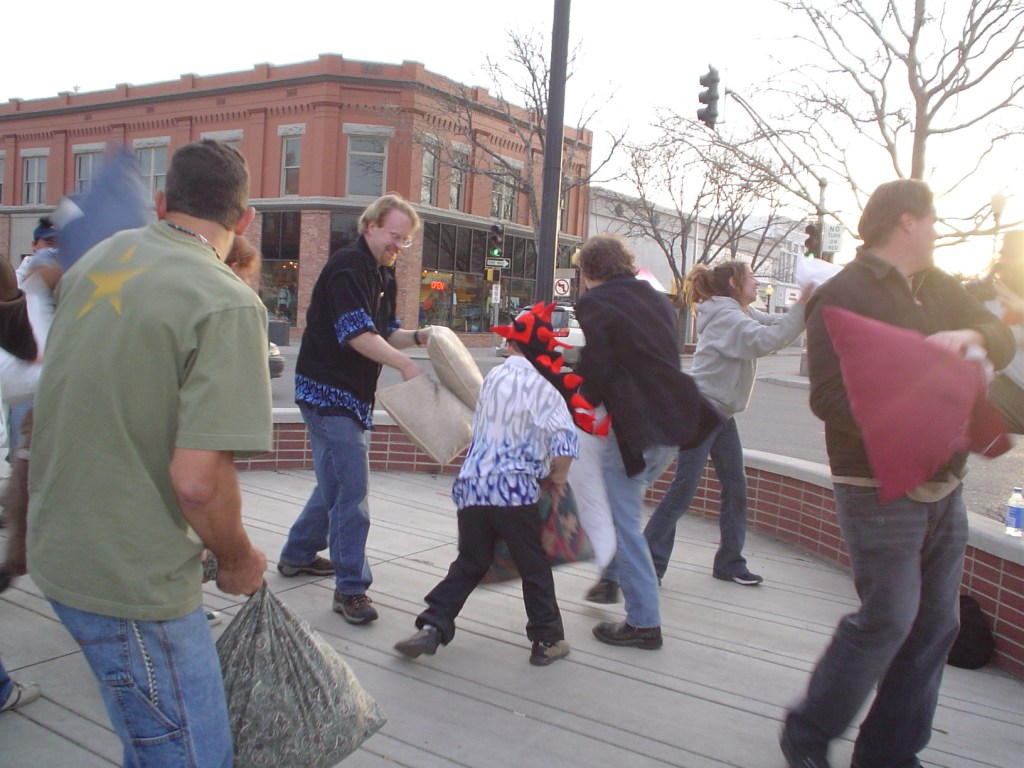
Fun is good—Even meetings need some levity. When making introductions include fun questions as well as name and pronouns. At the end of each collective house meeting someone would do “Share-Bear” and they would have to share an embarrassing story about themselves. It helped us get to know each other and created a space to reconnect after disagreements that may have arisen during the meeting. It humanized us and was a source of much laughter. Do the Hokey Pokey, sing “Solidarity Forever,” just do something that can become a fun tradition.
Always be Fishing—Always be flyering, tabling, stickering, have regular public facing events to recruit new members. A movement publication like The Revolutionist or back in the 2000s The Red Pill is something that can be handed to interested people. Always have something to hand out. All events are fishing events. Protests, speakers, screenings, etc without gathering emails (keep your people safe by using good informational security. Resources on the last page) and handing out literature is effort wasted.
Take people as they come—I like to ask people “What do you bring to the party?” Some people can write, edit, distribute, promote, some people can only sign a petition or send an email to their elected representatives. Some people can speak publicly. Some can staff a jail support number. Some can only write a check. Find ways for all people to engage at whatever level they can. Diversity of tactics includes petitions and letter writing campaigns as well as more direct actions.
Organize on issues and ideas not parties. For example, if you were to only organize anarchists, socialists and communists in Grand Junction Colorado it would be very slow going. But when anarchists and communists organize along a single issue we radicalize people that we interact with and often win battles along the way.
There were registered Republicans in both the anti-war movement and the local Occupy encampment. We didn’t shame them or talk down to them because they wanted the bombs to stop and the banksters behind bars just as much as we did.
Purity tests are movement killers. Conversely don’t be so broad that you don’t stand for anything at all.
Say yes to all resources—As you are looking for people, look for resources too. Take what is offered and then later find ways to utilize it. Sean McNeil was unhoused, and preferred the term ‘roofless motherfucker.’ Sean grew up in New Orleans, dropped out of school and spent most of his adult life earning an income as a street musician in the Big Easy. After Hurricane Katrina in 2006 he became a ‘proper tramp’ always on the move from town to town with his dog Duke. He became a major part of Housing First! No More Deaths! and Occupy GJ. He would often say: “Always say yes. Take what’s offered and find a way to use it later.” When a friend of the movement showed up one evening with an unused body bag we didn’t ask questions. Initially we didn’t know what to do with it, but we later used the body-bag as prop/costume protesting Dick Cheney and again when the GJPD murdered Brett Ingram.
Do the Unexpected—in 2010 an anti-homeless community group formed called “Friends of Hawthorn Park” they had a well funded astroturf feel and organizers tied to the tea party. They launched to much fanfare, circulating staged photos of a ‘homeless person’ passed out drunk in the slide in the local media. Their first public meeting was billed as a ‘play-date,’ concerned parents were told to bring their kids to a meeting in Hawthorn Park. Of course we salted the parents group with some progressive/radical parents. But we wanted to do more. Of course protesting a group of moms concerned for their kids safety was bad optics. Sean suggested that we spend fifty dollars of Housing First! No More Deaths! funds on dollar store toys and we send a clown to give the kids toys.
‘Hoboina’ the HF! NMD! clown arrived in full make-up and a multi-colored wig with a sack full of toys for the kids. The reactionaries showed their true colors in front of the media’s cameras, taking the toys donated by the unhoused community and throwing them away. Kids were crying and their parents’ cruelty was broadcast on the nightly news. The organization folded a few weeks later. A clown and $50 worth of cheap toys took down a well-funded anti-homeless organization. Money well spent. And more effective than more confrontational tactics.
Agency–Worry and panic breeds hopelessness. When things become overwhelming people need something to do. This was true when we launched the Grand Junction Mutual Aid Facebook group in the first days of the COVID-19 lockdown. Our local leaders were silent, the news was scary, things were uncertain, GJMA was something people could do. We started dozens of working groups that began to figure things out. 10,000’s of masks was sewn and distributed, a weekly distro day would evolve into Mutual Aid Partners, people were volunteering to shop for their at-risk neighbors. The group went from zero to 15000 members in just a couple of days. People were desperate to do something to help.
Trump’s re-election has the same feel, and we need to provide varied ways for people to take action. Agency is the cure to powerlessness and hopelessness. Give people something to do.
Consensus–is key. Robert’s Rules of Order is fine but be warned: a 51% vs 49% split on a controversial vote can split an organization in half, and more often than not the split does not result in two organizations, but more often in zero organizations. Even if you choose to use Robert’s Rules, strive to get everyone on side, listen to their concerns, and modify the proposals to address them. Consider requiring supermajorities to pass substantial proposals. If you can tell the room is split, don’t bring it to a vote. Kick it back to a committee and talk to the opposition. Try to make decisions that reinforce unity, not divide it. You might be able to push an unpopular measure through but at what cost?
Consensus process is an art. An experienced facilitator is a thing to behold. Switch roles, practice facilitating by serving as the co-facilitator, vibe watcher or note taker. Consensus always seeks to up-skill people. It can be slower but its more empowering and less divisive. Try using the “Fist to Five” method of consensus (additional resources on the last page).
Make the Informant Do Dishes— If you are doing anything that might actually challenge the powerful and the status quo, you will get infiltrators. They will often be pretty obvious. They will advocate for more violent and militant actions. They will usually have a pretty poor understanding of radical thought and history. They will be poorly read. Their back stories won’t match up, research it. Reverse image search is great, you might even find their class photo from the police academy. If they come in from outta town with a bunch of radical political experience, reach out to the organization they claim association with and see if people will vouch for them. Don’t accuse people until you have 100% solid evidence.
Many a Food Not Bombs chapters around the country have put suspected police undercovers to work doing the least desirable chores. Cops live in a top down world and follow orders well. They will wash those dishes so well—all in hopes of earning the trust of the group.
Security culture is important but should not be a roadblock. Rather security culture is a set of social guidelines that keep us safe and makes the informants easier to spot.
1. Don’t talk about illegal action with anyone other than your immediate crew. Don’t even joke. A transcript of your joke will look awful in court.
2. Don’t write down plans for illegal actions.
3. Don’t talk about illegal actions anywhere around your phone, the FBI admitted wayback in 2006 to being able to turn phones on remotely and use them as listening devices. Those capabilities have certainly expanded since then. Landlines are harder to tap and need a court order. Unusually high battery usage is a sign they might be using your phone to spy on you. (Additional security culture resources on the last page.)
Fear, accusations and paranoia will do more damage to your organization and ecosystem than the informant(s) ever could.
When you do have enough proof to act—act decisively.
When HF! NMD! launched. We invited everyone in the community to the meeting including police and city leaders. They choose instead to send two undercovers “Vic” and “Andy” whose shaved chests instantly put them under suspicion. A supporter, who was a former 911 dispatcher, said they were ‘probably’ cops and snapped a picture of them. Their stories about where their camp was located didn’t add up. Additionally, scanner traffic indicated that officers were on “special duty” in Whitman Park the morning of our initial meeting and no uniformed officers were present. And even then we didn’t act.
We suspected. We were watching them. After a couple weeks a core organizer was at the police station on other business and saw them leaving the Police Department out of a secured entrance.

Armed now with solid confirmation we sent out a press release and photo to all the media in the state. No one picked up the story, of course, but we BCC’ed the city council and the chief of police, and we never saw Vic and Andy again. Most importantly we didn’t spread fear and paranoia at the beginning of a movement.
Free Speech Ain’t Free And Elon Has More of It Than You Do—Take what you can get in this world. Only the elites of both capitalist parties can afford TV ads and billboards. Therefor to ensure our speech is as free at theirs we have to take risks.
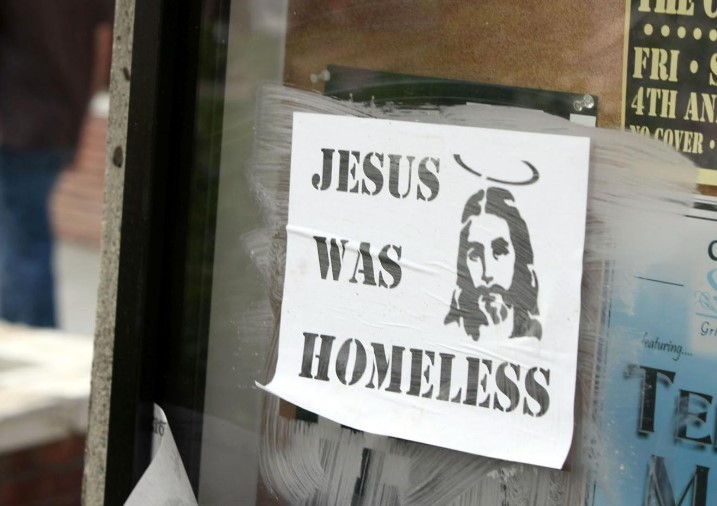
Tagging, wheat-pasting, and banner drops are a great, usually low risk, way to free your free speech. It also a great way to build internal group cohesion, and operational efficiency.
Don’t let them tie it to you. They can suspect all they want. All printers leave a bug, when making copies for wheat pasting, make a copy of the copy and copy of that copy, and so on and so on. Don’t leave drafts at your house or design files on your computer. Stencils are pretty low-bar when it comes to graffiti. And impactful. Ask Bansky
Stop-sings are low hanging fruit. Stencils and white spray paint, or red stickers with white lettering. STOP WAR, STOP TRUMP, STOP ICE, etc.
Don’t ignore letters to the editor, op-eds, ‘share army’ or ‘twitter storm’ style social media campaigns.
Political theater can garner earned media. A skit, a stunt or a creative action can get you real airtime and inches in the papers.
Organize what you Got—Organize where you are. If you are working 60-hours a week you need to organize your co-workers, and form a union. If you are in jail organize prisoners. If you’re a teacher organizer teachers.
Sun Tzu, Rumsfeld or Mao, one or all of them said you “fight a battle with the army you have not the army you wish you had.”
When there is a groundswell: an Occupy Wall St, a Coxy march, a BLM moment organize on that. Find concrete ways to link your ongoing projects to the momentum. Strike while the iron is hot. These uprisings are often flashes in the pan, and 95% of people will go back to their day to day grind sooner rather than later. But that other 5% will become the core of the slow movement organizing that happens when we fight intractable injustice.
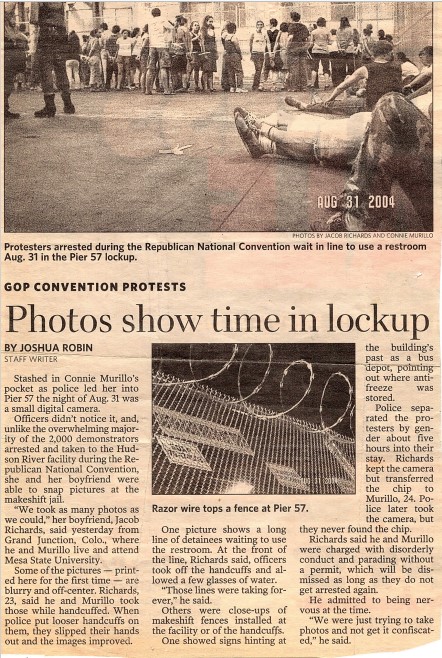
In 2004, Connie Murillo and I went NYC to cover the protests surrounding the Republican National Convention. We were caught up in an illegal mass arrest. They took us and other protestors to a undisclosed Department of Homeland Security detention centers in an outwardly abandoned pier. August 31, 2004 was the largest mass arrest in the history of the United States. We filmed our own arrest and documented things until they took our camera and put us into cuffs.
At Pier 57 they failed to search Connie very well, and after we were through intake, Connie still had a camera and a pen, and there were a thousand people who’s basic rights were being violated.
We documented the conditions, thumb over the flash so cops couldn’t see us taking photos. We also started collecting emails. Every used paper plate or scrap of cardboard we could find we filled with emails. It was the little pen that could. We found other people that understood the power we had through the mere possession of a camera and a pen. Together we made a plan. We got the chip from the camera and the scraps of paper with the emails though the next couple security checks. The email lists was the first step for a class action lawsuit, (did you know when you sue the government and win they tax your winnings). The photos were largely suppressed in the mainstream media, but they were used in the ACLU report, the lawsuit and published all over the alternative media infosphere. Organize what you got where you are at.
Marches—Taking it to the street can be both super empowering and a great way to garner earned media (especially with three T.V stations in this area with largely nothing to report on). One-thousand people or more might drive by you at 12th and North, but if just one of the stations show up, you have reached thousands more all across the region. Conversely, marching if you cannot pull the numbers can be demoralizing.
Taking it to the street at some level always puts people at risk. Being organized can reduce those risks. Have people trained in de-escalation and as street medics with first aid supplies. Actions in the heat of summer have to provide water, and take prevention of heat related health hazards seriously.
People are at the most risk of being attacked by fascist, super-patriots and Zionists when they are coming to and leaving the action. It is also important to march at a slow pace. An army can only march as fast as the slowest soldier. Bullies, chuds and wing nuts will pick on stragglers not the main group. Put elders in the front to set the pace.
Be clear on what the plan is. People have an irrational fear that organizers are going to march them off a cliff.
Starting point and time needs to be clear, as does end times and location.
Gather for a half hour after past the publicized start time. Before the march have a few speakers, and/or actions for people to take like petitions. This allows stragglers to arrive. This is also your time to organize, meet people and check in with allies and supporters.
Then march. Have your rally with music, speakers etc after the march. This enables you to march with the most people. Gathering up all the stragglers helps you look bigger, and keeps people safe.
Notify the press. Write a press release. Amplify you’re message! Have a designated person(s) that have practiced messaging for the media.
Symbols have power, use them. Have a clear message. A “Three-Word-Chant.” Federal legislation protest at the Federal Building, A county issue? Rally at the county court house. City issue—City Hall.
Consider having a police liaison. Especially if you are planning civil disobedience. A jail support number is essential if arrests are possible. We don’t leave our people to rot in jail!
Events need to have a start, a middle and an end. There should be a clear narrative with symbols that can be conveyed in the photos and video that will inevitably be taken.
After ten of us blockaded Sarah Palin’s motorcade in 2008, there was certain level of distrust, people didn’t show up to future events cause they didn’t know what we had planned. Be clear. Keep people safe. Have a beginning, middle and end.
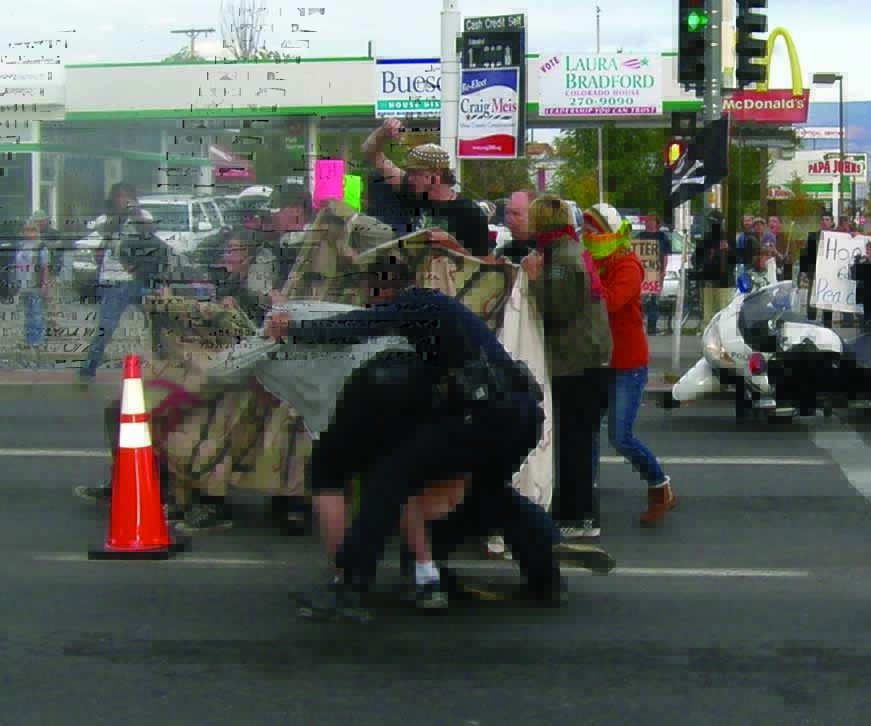
Filling in the Map—Join in with national day(s) of action. When a movement has that virality and every city and town in the country is participating there is usually a big blank spot in the national maps. Holding an action in Grand Junction boosts national movements by filling in the blank. The collective houses provided safe places for traveling radicals to stay, before hitching hiking or train-hopping to Denver or SLC.
Accountability—Set communications expectations. Be clear about needs and respecting others needs. Accountability is hard. We hold ourselves and each other accountable. Remind people about the tasks they committed to doing for the group. Be gentle. Have a separate person from the chair or facilitator and separate from the notetaker, write out tasks that people have committed to, making a slip of paper for each individual task to give the person that committed to it. The “task-master” should note when one person is over committing. Some of us don’t know how to say ‘No.’ It is never worth loosing your temper with your comrades. Make do; Adapt; Reassign tasks.
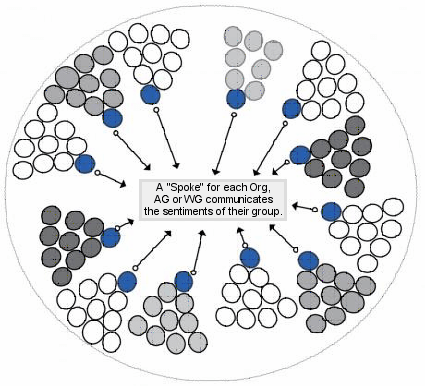
St Paul Accords: Organizing Orgs—A spokes-council is an excellent structure for organizing organizations. The St. Paul Principals, have been in use since 2008 nationally in building and organizing movements of resistance and in even more mainstream protests as well. Basically this is how organizations in a movement should treat each other.
1. Our solidarity will be based on respect for a diversity of tactics and the plans of other groups.
2. The actions and tactics used will be organized to maintain a separation of time or space.
3. Any debates or criticisms will stay internal to the movement, avoiding any public or media denunciations of fellow activists and events.
4. We oppose any state repression of dissent, including surveillance, infiltration, disruption and violence.
5. We agree not to assist law enforcement actions against activists and others.
Standing In Solidarity—We literally are all in this together. Try to find ways to stand in solidarity with other groups, people, and organizations. All of our issues are interconnected. More than doing the right thing, finding ways to act in solidarity will help you engage the broader community. You will meet new friends and allies that will stand with you when you need it. It connects issues: union issues are also chicanx issues, peace in Palastine ties into wealth distribution, environmental issues impact the poor and marginalized disproportionally. All of our struggles for a more just world are tied together, and we should always be looking to strengthen those bonds.
Founder’s Syndrome and Letting Organizations Die—Often organizations and non-profits become myopically associated with its founder. The founder probably has a strong vision and personality and is able to out of sheer will keep organizations going long after they should of folded. Founders should get out of the way as soon as possible, handing the reins over to the community at large. If the organization is doing good work with broad community support it will thrive after the founder steps down, if it’s a mini cult of personality it will flounder and fold rather quickly.
Charities often prioritize bureaucratic continuation over solving the problem they formed to address.
When working on the now fifteen year old, “10 Year Plan to End Homelessness,” the big charities in GJ objected to the “end homelessness” part of the plan’s title. Someone actually said out loud, “What would we do if we ended homelessness?”
Organizations are tools used to archive specific outcomes, if the organization isn’t getting us the results we wanted its 100% okay to let it die, freeing up time and resources to redirect to more effective means of making change.
Paper Tigers—Feel totally free to use misdirection in the form paper groups or single-action groups. In 2008, radicals in Denver and Minneapolis organized the RNC and DNC Unwelcoming Committees. That same campaign season John McCain, Barrack Obama, and Sarah Palin all made appearances in Western Colorado, and we protested them all. Counter protesting these politicians did not really fit with any organization we were working with, so we organized three separate “Unwelcoming Committees.”
Another time we had some traveling crusty-punk anarcho-kids attend the Grand Valley Coalition for the Homeless and introduce themselves as the Grand Valley Squatters Union… the police spent weeks asking people on the street about the Squatters Union… let them chase their tails once in a while. Suddenly HF!NMD! wasn’t the biggest threat in town—reasonable even, in comparison.
Open Gates Don’t Keep Them—Making a decision between five people can be easier than one hundred. But what you save in time you will lose in power. Inviting your base to a sit down with a county commissioner is a sign of respect and will increase commitment. Always invite as many people as you can to a space. Let the person you are meeting with say no. Facilitation is key in these moments so coming into a meeting with set goals and objectives is paramount. Use the numbers to your advantage. If the meeting is only for a “select few,” find a bigger venue. Someone will think of a question, comment or notice a difference making opportunity that the “leaders” might miss. If you are noticing small groups forming to make decisions, push to open those gates. “Alone a youth runs fast, with an elder slow, but together they go far” – Luo (East African) Proverb.
Mutual Aid, Solidarity and Anarchism in GJ
By Jacob Richards.
Originally published in The Grand Junction Daily Sentinel, June 2020.
If someone had told me in February that I would be doing community organizing again after eight years off, I wouldn’t have believed them.
In my youth, I was a loud and active organizer on numerous social justice issues in the Grand Valley. I spent my twenties organizing against the wars in Iraq and Afghanistan, for basic human rights for homeless folks, running for local office, and fighting for a better environment. I cut my teeth fighting uphill battles in this seemingly politically hopeless town. I have traveled nationally: New Orleans post-Katrina, Tuscon as a guest editor of the Earth First! Journal, and I have been pepper sprayed in numerous cities, in police riots, where the cops just simply attack peacefully assembled protesters.
When I left the Grand Valley in the beginning of 2012, the chief of police called to see if the rumors of me leaving town were true. GJ was rid of its anarchist.
While I reinvented myself as a wilderness fishing and hunting guide, Grand Junction continued to ignore the march of progress. All the same problems that existed in 2010, when I got three police officers fired for vandalizing a homeless encampment, still exist today in 2020, just worse for the wear from another decade of inaction and neglect.
I am sure it turned heads when I got second place in a five-way City Council race in 2011, as an avowed anarchist and ex-con, but people then craved what they crave today. People want liberty and justice, and they want it straight, no bullshit.
Anarchist is a scary word, especially in the wake of the national uprising following the murder of George Floyd. The media and the billionaires have always feared the ideas presented by anarchism. For well over a hundred years they have used their wealth and power to demonize an ideology that most free humans readily subscribe to.
Anarchism has three basic tenets: Mutual Aid, Solidarity, Direct Action.
The first of those, Mutual Aid, might ring a bell to some of you all. Around ten percent of the Grand Valley has joined Grand Junction Mutual Aid (GJMA), or one of its many active subgroups, or one of the regional mutual aid groups which I helped start in the wake of the Covid-19 Crisis. These groups are thriving in the mainstream population, from Delta to the upper Roaring Fork Valley.
It’s simple, really: help your fellow human. Ask a 5-year-old if a hungry man deserves to eat, and without fail they say yes. It takes a lifetime of state education, corporate media, and social stigma to unlearn our basic humanity.
I have seen our community rise up to help one another, and many everyday heroes live here. If I were to try to name them, I would only do a disservice to those I was unable to mention. Our GJMA mask team has sewn tens of thousands of masks for essential workers and healthcare workers here and regionally. Our distribution team and community partners make the most organic redistribution of needed supplies happen every Tuesday 10am-2pm at 536 Ouray Avenue. The main GJMA Facebook page continues to be a place for people to place offers and needs out to the community at large. I have not seen a single realistic need not be met by the generosity of the people of the Grand Valley. The people of Grand Junction responded to COVID far better than our local governments did.
Solidarity is the idea of standing with others in their fights for justice. Solidarity is not crossing a picket line. Solidarity is recognizing the truth of MLK when he said “A injustice anywhere is a threat to justice everywhere.” Solidarity is watching our mostly white community come out in force to support the national uprising, and stand behind local people of color making real changes here and now. Solidarity is standing with those without power, with those who struggle everyday, those have gotten the short end of the stick. Solidarity is siding with the people, not the powerful.
The organic organizing that has come to form a united front to combat injustice in our town is now an organization called Right and Wrong (RAW). This group shows me—along with the diverse attendance at their events—that solidarity is alive and well.
To understand direct action, we must first understand indirect action. Our representative based democracy is a perfect example of indirect action. We vote for some piece of shit to “represent” us in congress, but do they? This is why close to half of all eligible voters don’t vote. Indirect action is dis-empowering to the individual and their liberties, it’s placing a bet on red or black, and spinning the wheel. House wins. Signing petitions, peaceful protest, and lobbying your representatives are all forms of indirect action.
Anarchists prefer direct actions; see a problem fix a problem. So do the American people. The burning of the third precinct in Minneapolis polled recently at 54% approval. Some perspective: Biden was polling at 48% and Trumps at 41% approval. Direct action can mean riots and violence, but also means feeding the homeless in the parks, which Solidarity Not Charity has done for 12 years in this community, or sewing thousands of masks while the local state and federal governments screwed the pooch on PPE. Both certainly have their place, and I encourage everyone to vote, but I also encourage everyone to use the 364 days a year we are not voting to build a world we want to live in.
These are strange days. Our future is more uncertain than maybe anytime in living memory. I am not the ideologue of my youth, I don’t think the world could possibly run along anarchist tenets, but I know that if more of us incorporated these three ideals into our daily lives and struggles, we would live in a better world.
###
Jacob Richards is a long-time anti-authoritarian community organizer and writer based in the Grand Valley, on Colorado’s western slope. Richards has founded and co-founded numerous
grassroots groups and mutual aid projects spanning three decades of activism, organizing and resistance. Jacob is the editor and co-founder of The Revolutionist.
Further Reading and Resources:
Books:
Rules for Radicals–Saul Alinsky
Recipes for Disaster: An Anarchist Cookbook–Crimethinc
Come Hell or Highwater: A Handbook on Collective Process gone Awry–Delfina Vannucci and Richard Singer
Earth First! Direct Action Manual (DAM)
The Revolution Won’t be Funded–INCITE!
Emergent Strategy—Adrienne Maree
Tools for Radical Democracy—Joan Minieri and Paul Getsos
Starting Somewhere: Community Organizing for Socially Awkward People Who’ve Had Enough—Roderick Douglass
Websites:
https://www.facilitator.school/
Podcasts:
Listen, Organize, Act!
Live Like the World is Dying
Bad Activist
Print and distro at will. Flip on ‘short-edge.’

 The Revolutionist
One thought on “Grassroots Organizing Demystified”