
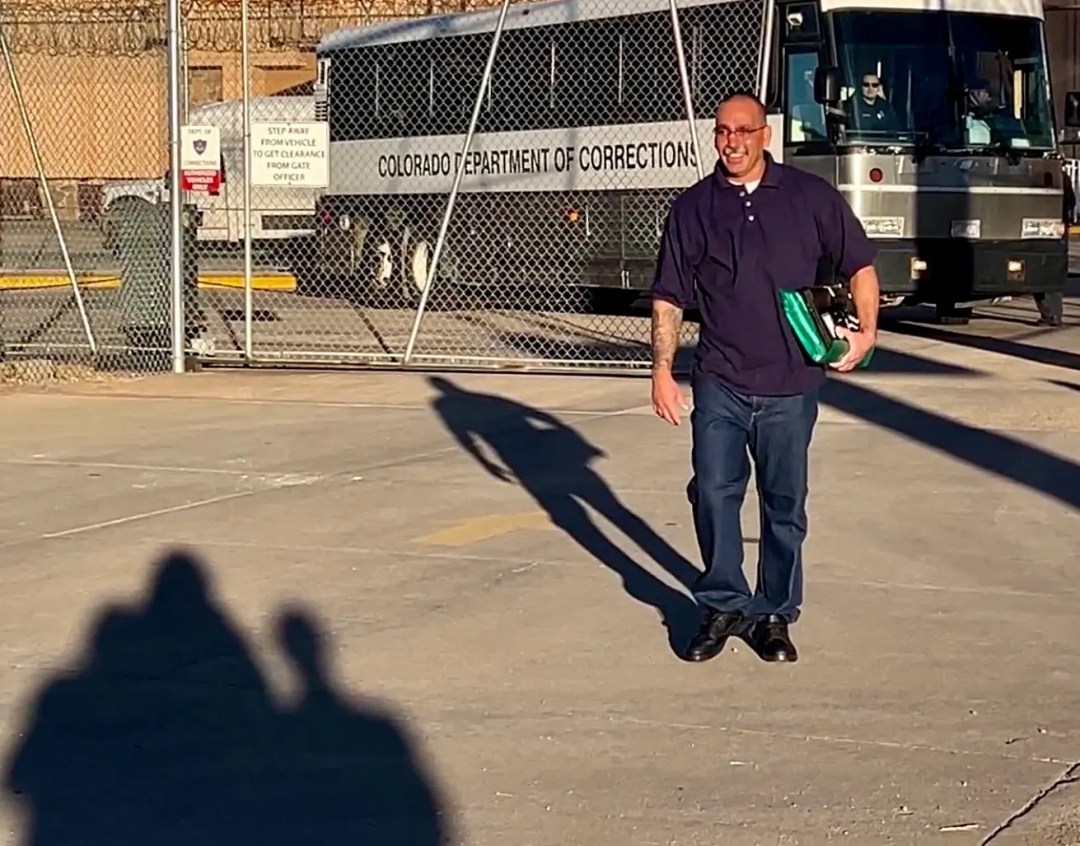
By Juan Espinosa, Courtesy of La Cucaracha
They say, we learn from our mistakes. David Carrillo, 51, wants the young men and women he encounters to learn from his mistakes.
As a 19-year-old gang leader, Carrillo was convicted of first degree murder of a young man in 1993 who wanted to quit the gang. He was sentenced to life in prison without a chance for parole.

That easily could have been the end of Carrillo’s life outside of prison had it not been for his internal search for redemption. It was a long and harrowing road, including serving almost 31 years in Colorado state prisons, but Carrillo escaped his fate of life in prison and recently spoke in his home town of Pueblo to offer hope to others who are on their own self-destructive paths.
In 2023 three days before Christmas, Carrillo received an unexpected gift. Colorado Gov. Jared Polis granted his request for clemency and he was to be released on parole the following month.

In November of this year, Carrillo spoke at the Patrick A. Lucero Library to a dozen youths involved in Mark Salazar’s Hardknox Gang Prevention and Intervention program. Carrillo told them the secrets of his own success.

“I let them know that regardless of what they’re going through, their destiny is not written for them,” he said in a recent interview with La Cucaracha News. “I didn’t realize the power of choice that I had.”
Carrillo talked about the choices that led him to prison and the ones led him out of prison and into academia as a college professor.
“I was one of the originators of the Young Crowd, a Pueblo gang in the 1990s,” he said. “Like a lot of young kids (in gangs), we were trying to figure things out… We were looking for family, brotherhood and protection.”
He and 16-year-old Michael Montoya were convicted of first-degree murder in the shooting death of Chris Romo in 1993 and were sentenced to life without parole. The “shooter” was Carrillo’s younger brother Anthony “Shorty” Carrillo. Shorty accepted a plea bargain for the murder and was released on parole in 2019.
After the U.S. Supreme Court ruled that sentencing juveniles to life without parole was unconstitutional, Montoya was released from prison in 2023.
Even though he did not shoot Romo, Carrillo was charged with murder because he was over 18. Years later, he says he learned “you have to take responsibility for your actions… Romo died because of our actions.”
In his talk to the Pueblo youths, Carrillo talked about is early years in prison. ‘I was 5’11” and weighed 110 pounds and was scared and nervous.”
One of the first things he did in prison was to ask a friend for a knife. He also became involved with a prison gang known as the Gladiators. “We had to stud up to defend ourselves.”
“I was in a high-risk prison and they sent me to a more secure prison where I got involved in smuggling drugs into the prison,” he said. “They put me in solitary confinement…I was there two years. Nobody talks about the loneliness. You feel abandoned.”
He eventually was released from solitary. “I was constantly being watched. I got busted bringing in a lot of drugs and was sent back to solitary.”
Solitary had him asking himself, “Is this the best the world has to offer me? That’s all I had to offer to the people I loved. I’m in my cell thinking, something has to change. I asked myself, what do I change to? I was tired of leading all these people into this way of life.”
Change came at a slow pace. “I started Teardrop Creations, a business,” he said. “It gave me a sense of pride. I earned a certificate.”
A prison riot set him back temporarily. He got involved trying to help a friend who was knocked out in the melee and was written up for engaging in a riot. He was sent back to solitary for the fourth time — back to isolation, loneliness and contemplation about his next move. He found inspiration in books.
“I wanted to start leading my people out of prison,” he said. “A book by Stephen R. Covey — Seven Habits of Successful People — I learned it and taught it.”
That began his transition into seeking more education. He enrolled in a paralegal course and earned an associate arts degree in paralegal studies. Next step was a bachelor’s degree in business.
“A lawyer started working with me,” he said. “I earned my masters degree in Business Administration — at the ceremony, they gave me my master’s hood.” Little did he know that hood was change his life.
Adams State University in Alamosa hired Carrillo to teach Introduction to Business 101 to other inmates for college credit. “I was at the first incarcerated college professor in prison,” he said.
“I don’t teach what to think, but how to think,” he said. “You can create anything you want. Everything, that chair (pointing to a chair in the room), was once a figment of somebody’s imagination.”
As he spoke to the group consisting of 13 juveniles and a half a dozen adults, Carrillo seemed to transition from the former prison inmate and take on the persona of the professor he is.
Since his release, he has completed his parole and he continues to teach college classes inside several Colorado prisons. That night in Pueblo was the first time he has talked to youths about his prison experience.

He was invited by Salazar, a former gang member who also served time with Carrillo. Salazar has been working with Pueblo juveniles for two decades.
“I do groups once a week at the probation department,” Salazar said. “Many are active in gangs. The kids who are out in the streets shooting at each other, those are the groups I work with.”
Since 2006, Salazar has used physical and mental exercise to create a bond between himself and his young clients. He established the Hardknox organization and in 2015, it became a full-fledged nonprofit entity. In addition to his program at the Lucero Library, he has a caseload of 16 kids on probation and also works with the Pueblo County Department of Social Services. In a typical month, he averages 300 contacts.
“I talk to them about how to control their emotions rather than have their emotions controlling them.”
“I take them to the gym to play basketball and chess,” he said. “You have to make the right moves to win. I teach them the 10 commandments of chess and we’ve developed some good players.”
Each of the juveniles at the meeting received a copy of Carrillo’s autobiography, “Kiko: From Life Without Parole to Life With Purpose.” Kiko is available on Amazon.

“This isn’t just a prison story—it’s a journey of accountability, resilience, and change,” Carrillo said about his book. “Against all odds, I earned multiple degrees and became the first currently incarcerated individual in the U.S. to be hired as a college professor, teaching business and economics to other incarcerated students. Through education, self-reflection, and mentorship, I discovered purpose and redefined what freedom truly means.”
###
The Revolutionist is 100% volunteer run and subscriber funded. We do not sell our soul for advertising dollars, nor do we prostrate ourselves for grants from the non-profit industrial complex. We are community media. Join the community! Subscribe today at whatever rate you can, and get a hard copy of The Revolutionist in your mailbox. Subscribing subsidizes free distribution copies.


 The Revolutionist