
by V4MPIREBAIT
If you’re online or out amongst the young people these days, you’ve seen a goth kid. Maybe they’re casual, just adhering to an all-black color palette. Maybe they go big, the teased-up bat’s nest of hair, stark-white face paint, thick dark eyeliner and contouring creating a high-contrast, high-impact look. Maybe they’re more mysterious, with a long, black jacket and quiet demeanor evoking a plague doctor or perhaps channeling some vampirism. Whatever the look, goth is in – and it’s everywhere. However, a lesser-known part of the whole shtick is actually not even about aesthetics. For most Goths, there’s a personal ethos in following the culture. Exploring where that comes from is truly the root to understanding what being “goth” is all about. Goth has always had a little punk hiding in there, and that’s why the Goth Renaissance isn’t following the typical 20-year trend cycle – it’s not just a look. It’s a movement.
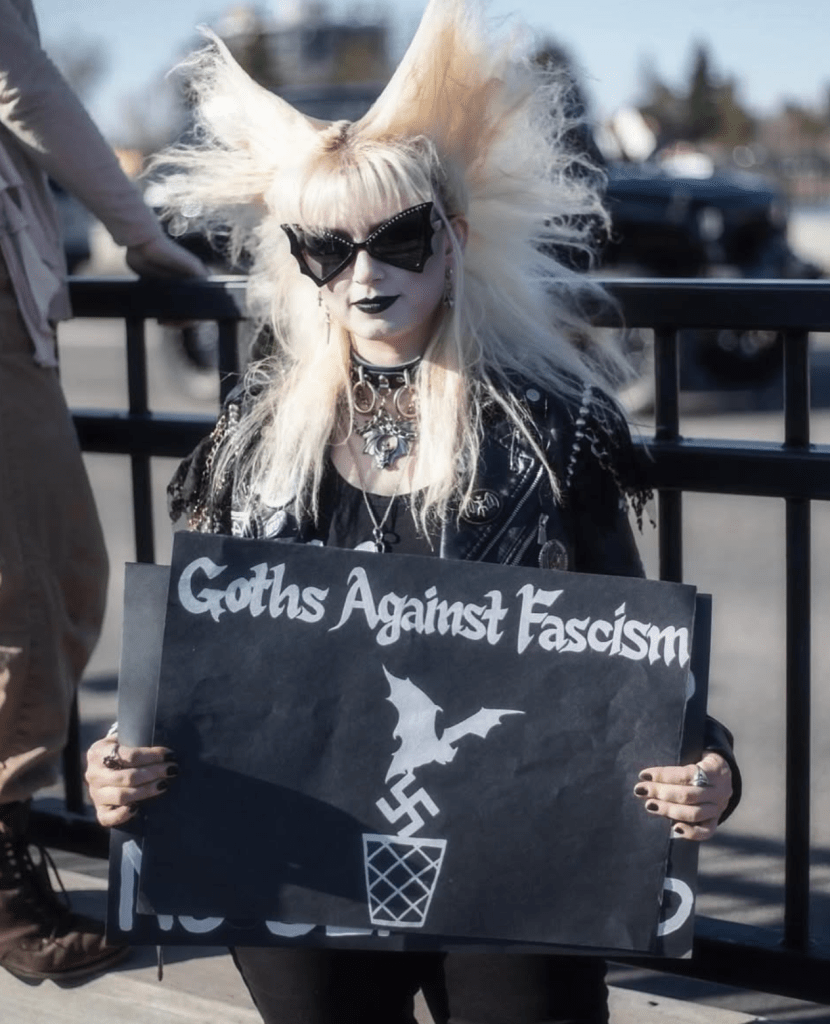
As with any culture, a strong counterculture often develops. The Goth scene was born from the Punk Era toward the end of the 70s, a time in which global tension were rising with the Cold War, the HIV/AIDS epidemic nearing, and conservative western leaders like Margaret Thatcher and Ronald Reagan were in power (for further reading into the UK punk to goth movement, try Goth: A History by Lol Tolhurst, founding member of The Cure).
We are now in a time where conservative/traditionalist expectations are very high and very prominent, political tension is the worst we’ve seen in decades on a global scale, and goth culture is making a comeback in response to that growing cultural conflict.
Goth is not just about the music or the fashion. It is and has always been an intentional movement that challenges the status quo— anti-racist, very pro-queer and pro-inclusivity, anti-consumerist, class-conscious, sex-positive, all of it. At the heart of goth culture, the ethos is to be authentic to yourself and live in a way that is for the good of all people, for that is what gives life a deeper significance.
As punk evolved into post-punk and goth in the 1980s, tension continued to rise around the globe – not only was the Cold War once again coming to a head, but fear from the HIV/AIDS epidemic was mounting with every death that passed (over 200,000 people in the U.S. passed away from complications between 1981-1992, so one can imagine the global toll). Through this unimaginable hardship, the queer community was committed to thriving despite the discrimination. Because the goth subculture had so many of the same values as the queer community – anti-discrimination, fighting for the rights of everyone, and embracing differences – there was quite an overlap between communities, each borrowing and building from the other, supporting each other, and frequenting the same clubs and other hangout spots. In particular, New York City became a hub for countercultures, especially the famed “club kids” of the 80s and early 90s, and amongst these communities goths and punks could always be found. Drag-inspired and DIY styles in both subcultures were a form of rebellion and celebration in the face of widespread despair, almost like a visual signal, saying “if you are different, you are safe with me, we are in the same fight.”

Keeping all of this in mind in tandem with how eerily the political landscape now echoes that era once again post-COVID, it’s no wonder the youth are engaging in darker looks – it’s a reflection of the world we live in. We are in the same fight as our predecessors.
In addition to the rebellious fashion element, a large part of the goth ethos lies within the music. For example, Boys Don’t Cry by The Cure challenges the expectation of men to keep a “stiff upper lip” through heartache. At the time of release in 1979, it was still quite subversive for men to admit feelings of upset at all, let alone to the point of shedding tears, especially over something like romance. Even in the alternative subcultures, there was still an expectation to turn those emotions into a revolt, as displayed by the punk movement just prior. The song illustrates the conflict in emotions that the Goth Movement confronted – having to hide how you really feel in an attempt to preserve a masculine image, conforming to societal expectations. This is where goth takes a bit of a detour from its punk roots. Instead of transmuting feelings of sadness into anger and aggression, that sadness is simply embraced, creating a different, gentler kind of rebellion.
In a more current instance, Dusty Gannon of Vision Video has been a solid example of upholding that subversion of masculinity. Now a staunch anti-war activist, Gannon served in the Afghanistan war post-9/11, witnessing massive violence overseas.
Kandahar, a track from their debut album Inked in Red, describes the unimaginable grief and weight of being directly involved in the war at hand. A specific verse toward the end is a haunting reminder of what every person who has served in a military operation in the U.S. or otherwise has had to face – “I am gutted all the time / An abject horror turns the twisting knife / And we’ll remember every act / And wander the desert ’till we diе.” It is a stark, literally gutting description of the post-traumatic weight they must carry for the rest of their lives. Rather than romanticizing that time or glorifying imperialist violence, Gannon has used Vision Video as an outlet to drive home the point of the culture – in an interview with Jonny Leather, writer for Asheville Stages, he stated “It’s not just a bunch of weirdos wearing black makeup and listening to The Cure. There’s real implications of what’s going on in subculture via goth, punk or whatever you want to call it. This stuff matters, and it matters in a big way.”

So, now the question remains: Why is there still an ongoing debate on what the Goth Subculture is about? Is it because of the consumerist nature of the new wave of baby bats that haven’t yet been taught the cultural beliefs and social evolutions behind everything? With websites like Dollskill.com selling cool clothes in mass quantities, it can be easy to get the look without having to think further about the implications. If someone doesn’t show the newbie the magical thrill of DIY style, they’ll take a long while to find it themselves, let alone consider the conflict in supporting a fast-fashion brand whose infamous controversy is selling a shirt printed with the phrase “goth is white.” Is it the baffling concept of a “conservative goth” somehow being accepted and entertained in online debates?
The co-opting of punk and goth styles is often an intentional move, an attempt to enter these communities despite the massive contradiction of values. While Nazi skinheads are nothing new, one would think everyone’s grasped the notion that goth and punk are explicitly anti-conservative cultures by now, especially given the history. Or maybe, just maybe, is the debate part of the culture itself?
The “poser” debate has been around almost as long as both goth and punk themselves. The Cure, the band who famously refused to claim the goth label in years past, made a song all about it called “Jumping Someone Else’s Train,” an ode to the bandwagoning behaviors that alternative cultures often must grapple with. Whatever the case may be, goth is around and it’s here to stay – maybe we should become familiar with what it means not just for the individual, but for the culture.
###
The Revolutionist is 100% volunteer run and subscriber funded. We do not sell our soul for advertising dollars, nor do we prostrate ourselves for grants from the non-profit industrial complex. We are community media. Join the community! Subscribe today at whatever rate you can, and get a hard copy of The Revolutionist in your mailbox. Subscribing subsidizes free distribution copies.


 The Revolutionist