
The Revolutionist: Thank you for taking the time to talk with us. You both have a long and impressive history with journalism, community organizing, and movement building largely on the front-range. Our readers would love to hear about Ray Otero and the Chicano (and anti-Vietnam war) Movement here in Grand Junction and on campus, and how you both became involved in these movements?

Juan Espinosa: I spent 1968 on the flight line in Danang, Vietnam with the Air Force. Because I believed then (and still do) that our F4 Phantom jet fighters had shot down 13 of our own Army helicopters, I became a conscientious objector, though I didn’t know the term at the time. When I learned of the anti-war protests, I wanted to join. After I was discharged in 1969, I enrolled at Mesa College and attended an anti-war rally on campus organized by the SDS. On Mexican Independence Day, Sept. 16, 1970, I was sitting in my Colorado History class when I heard shouts of “Chicano Power!” coming through an open window. We all turned to see a procession of young Chicanos waving a Mexican Flag pumping the air with their fists. Even though it was one of my favorite classes, I packed up my books and followed the group to a rally on campus. Ray Otero, a Vietnam veteran, was the leader of the group and spoke about Mexican Independence Day, the Mexican Revolution and the Chicano Movement. That’s the day I joined the movement.
Deborah Espinoza: First, thank you, for considering our stories. Particularly since Juan and I are from the Western Slope. I didn’t know Ray Otero early on, but I knew of him because of a good friend, I knew he had recently returned from Vietnam.
Actually, the same friend called me one day and asked if I had heard what Ray was doing. I hadn’t. She said, “He’s saying George Washington is not the father of our country and he’s marching down the streets with a bunch of kids! I said, “Well that’s stupid, of course he’s the father of our country… how embarrassing! Why is he doing that?”
It’s funny now, but I think how brave Ray was to demonstrate and how elementary our education was at that time. I was still in high school and believed we were right to be in Nam. I share that story, because it is so indicative of our assimilation and our acceptance of American History, as it was taught to us. The U.S. is our home, but we had no idea of our true lineage and legacy.
Since Ray was a veteran, he had his own education. The same education, Juan received in Nam. They came home antiwar and ready for change. Of course, Juan was a big influence on me and opened my eyes.
We went to Boulder in 1971. Juan and I were ready to learn all we could, but Ray was already a leader in Grand Junction and the San Luis Valley. At CU we took the first Chicano History classes, learned organizing by watching and participating in meetings, demonstrations, picket lines, volunteering and listening to speakers at rallies and marches. We were students of the movement, as well as being on track to graduate.
Rev: What were the reasons, motivations, and goals that led to publishing your first Chicano paper El Dario De la Gente in Boulder? and later La Cucaracha in Pueblo?
JE: The main reason was that as co-editor of the Mesa College Criterion, I learned how to make newspapers. When I transferred to the University of Colorado in Boulder, I enrolled in the School of Journalism as a prerequisite to attending Law School. I got a work study job with UMAS Publications and helped publish Somos Aztlan Magazine. In the spring of 1972, UMAS-EOP Assistant Director Ricardo Falcón was fired by the CU administration. Hundreds of Chicanos on campus and from surrounding communities marched on Regent Hall in protest. At the end of one of the protests, I approached Falcón and UMAS President Florencio Granado and told them, “You guys need a newspaper to tell your side of the story and I know how to make newspapers.” Granado asked me what it would take and I told him for $250 I could get 5,000 newspapers printed. The next day, he gave me a fat little envelope that contained exactly $250 in ones, fives and an occasional 20. Dave Martinez and I produced two editions supporting Falcón. A faculty review board investigated Falcón’s firing and determined that the University didn’t have grounds to fire him initially, but because he had participated in the protests, they did have grounds and they upheld his firing. Falcón, Granado and about 70 to 80 UMAS students were suspended and kicked off campus. That’s when I decided we needed a Chicano newspaper to tell our stories. I got a commitment from the new UMAS-EOP administration to support El Diario de la Gente with advertising. I recruited Pablo Mora who was already in the J School. We convinced two professors — Russell Shain and John Mitchell — to give us independent study credit for starting our own newspaper.

Rev: Clearly the Revolutionist is in the model of the underground papers of the 1960’s and 1970’s, what can organizers and activists today learn from the importance of people powered media back in the day?
JE: Independent underground newspapers were one of the few ways to reach the masses in those days. There were three major television networks, mostly AM radio stations and major newspapers — all costly mediums out of the reach of most grassroots organizations. The development of the offset press opened the way for access to printing newspapers because of reduced costs. Small publishers could buy press time on a daily newspaper’s press or use the developing speedy printer businesses. Today, anyone with a smart phone and a computer can produce print publications, video documentaries and hi-quality audio recordings. Ironically, the hometown daily newspaper is now on the endangered species list because companies like Gannett have bought them up, liquidated their assets and reduced the reporting staff to a fraction of what they were before 2000. Under Gannett, 500 newspapers now have the same stories, photos and political views.
Rev: There is an old saying that “journalism is a first draft of history,” and the archives of El Dario and La Cucaracha are so important to historians today looking at the Chicano Movement of the 1970s and 80s. What’s the importance of documenting dissenting voices, and archiving social movements?

JE: Creating archives was not even an objective at the time. We were just trying to report the news that was being ignored, distorted, misrepresented or blatantly untruthful. Perhaps the most serendipitous outcome of digitizing our old newspapers is that the letters to the editor are also preserved. Those letters truly are the voices of the people.
DE: Personally, I chose history as my career and worked as a museum director for History Colorado, so I have great respect for archivists. During Covid, I was hired as a temporary director of the new Aztlan Research Center, at CSUP helping to set some of the first policies and organizing their first Summer Institute. Archiving dissenting voices and documents, is vital because they spark awareness, whether it be broad or an individual experience. Self-determination should be our first right, as citizens, but it is denied to people of color, when we are poured into the big, “Melting Pot”. Corky Gonzales was right, when he said in his poem, “I Am Joaquin”, about the Chicano experience, “We are lost in a world of confusion.” History repeats itself and social-movement materials preserve validity of struggles for human rights.
Rev: We were excited to see the relaunch of La Cucaracha, a few years ago. What about today, is similar to the situation of the 1970s. Why do you think there is a need for grassroots movement media today?
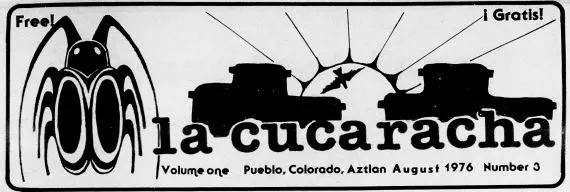
JE: The mission hasn’t changed. There is a continuing need for independent thinking, now more than ever. We are living in a time when misinformation is the norm. Fortunately, we have many new tools for disseminating information including social media like Facebook, YouTube, and TikTok, to name a few. At a fraction of the financial overhead of printing, La Cucaracha News.com website has been able to reach more readers more regularly than it ever did before. We’ve only been online for a couple of years, so it may be too soon the predict how it will all play out. By the way, El Diario in Boulder is also online.
Rev: Juan you followed up your work with two Chicano papers with a twenty-two-year career at the Pueblo Chieftain. What was the transition from grassroots journalism to mainstream media like? How are the two forms different in your opinion?
JE: I was lucky, when I went to the Pueblo Chieftain, I took many of the stories I had been covering in La Cucaracha with me. To their credit, my editors at The Chieftain recognized I had developed reliable sources and allowed me to continue reporting on stories like the law suit filed against Jack Taylor in San Luis, Colo., by the heirs to the Sangre de Cristo Mexican Land Grant, the rise of gangs and drugs in the barrios, and systematic racism in every corner of society including, law enforcement, education, health care and employment. I also got to teach a little Chicano Studies and cultural history in my weekly columns.
REV: You both have been involved with community movements and projects for decades, to what do you attribute your longevity in the struggle to? What keeps you coming back to the fight?
JE: My wife. She has been with me every step of the way. The Chicano Movement has become a way of life for our family. We have developed a support network of like-minded people, including our four daughters.
REV: What advice do you have for people first coming into activism and community organizing now?
JE: The need is greater than ever. We are experiencing a new wave of fascism, racism, attacks on civil rights, mass hysteria against immigration and attempts to distort our history and accomplishments. To new activists, I say welcome. Arm yourselves with knowledge and skills that will sustain you through the hard times. Learn to love, laugh and celebrate the good things in life. Set your goals high and just beyond your reach.
DE: For me activism is an avocation, it’s in my heart. My heroes are nonviolent. Not everyone has to be an activist for life, but they can always educate themselves to the issues and take action. We find ourselves in a fight for democracy, at this point in time. Your most basic rights are being infringed upon. It’s vital at this time. Put yourselves out there, and be a part of change, volunteer, document, but keep it peaceful. Don’t create heat (danger with police, or ICE, agitators, mass arrests). None of that helps, it only creates congestion in a movement.
REV: We saw a recent call to action from El Movimiento in Pueblo, how can our readers help Pueblo’ community fight against using your municipal airport being used for ICE deportations?
JE: ICE is everywhere. If you are brown, black, or perceived to be the enemy within, they are coming for you. We all need to resist ICE wherever we encounter it. We will fight and resist in Pueblo. Do the same in your own community.
REV: You both have done 100s of interviews over the years, is there any question you wish interviewers would ask but they never do?
JE: When did you know you wanted to be a journalist? The day President Kennedy was assassinated. I had just turned 15 and was eating lunch at home and watching TV when a bulletin came across, “President Kennedy has been shot.” I knew my classmates who were strolling back and forth in front of the high school did not get the bulletin, so I jumped on my trusty Vespa motor scooter and rode up and down the street shouting, “The president has been shot! The president has been shot!”
TR: Thank you for your time, and efforts for the community, and thank you for your time talking to us today.
###
The Revolutionist is 100% volunteer run and subscriber funded. We do not sell our soul for advertising dollars, nor do we prostrate ourselves for grants from the non-profit industrial complex. We are community media. Join the community! Subscribe today at whatever rate you can and get a hard copy of The Revolutionist in your mailbox. Subscribing subsidizes free distribution copies.


 The Revolutionist