

by Thomas Acker
Roberto Rojas, a Colombian citizen, entered the U.S. from Mexico three years ago. He requested asylum then. Robert has a Social Security number and a work permit, but he decided not to pursue his asylum case after paying a Florida attorney $5,700. The attorney kept adding fees but never resolved his case. He had an appointment scheduled with USCIS for 2027.
For three years, he has been working in various occupations in Florida.

In early December 2025, he was sent a notice by Homeland Security Investigations to attend an ICE check-in in Orlando, FL. He was told not to bring his cell phone.
Because of the worrisome way that he was seeing ICE enforcement, Roberto decided to return voluntarily to Colombia. He purchased his ticket at the end of November to fly back before he went to the ICE check-in.
At the ICE office, he was received by a polite ICE official and then ushered into an adjoining smaller office to have his fingerprints taken. At that point, Roberto observed a stark change in the demeanor of the official. He became rude. There were four large white agents in the small room. They shackled him hand and foot. Into that smaller room came a Guatemalan father with his 18-year-old son, Cubans, both of whom had asylum cases pending. In all, they detained 25-30 persons that day. All signed that they wanted to self-deport. Twenty-five percent appeared for ICE check-in, 75 percent were detained in ICE raids.
Afterwards, eight detainees were placed on a bus and driven to “Carcel 33” (“Jail 33”), the Federal Detention Center (FDC) in Miami Dade County. “Between 12 and 1 AM, they made us remove our clothes and strip-searched us. We were given disposable prison suits to wear and sandals. For three days, we were shuttled between the ICE facility and the FDC in Miami Dade.” said Roberto
Robert signed that he would not fight his case.
They were loaded into a van and told they were going to the airport — all passengers signed “to the airport,” acknowledging their understanding of the destination. Their shackles were locked to the floor of the bus. Five additional individuals were picked up on the way, and two hours later, they arrived at Alligator Alcatraz in the middle of the Everglades.
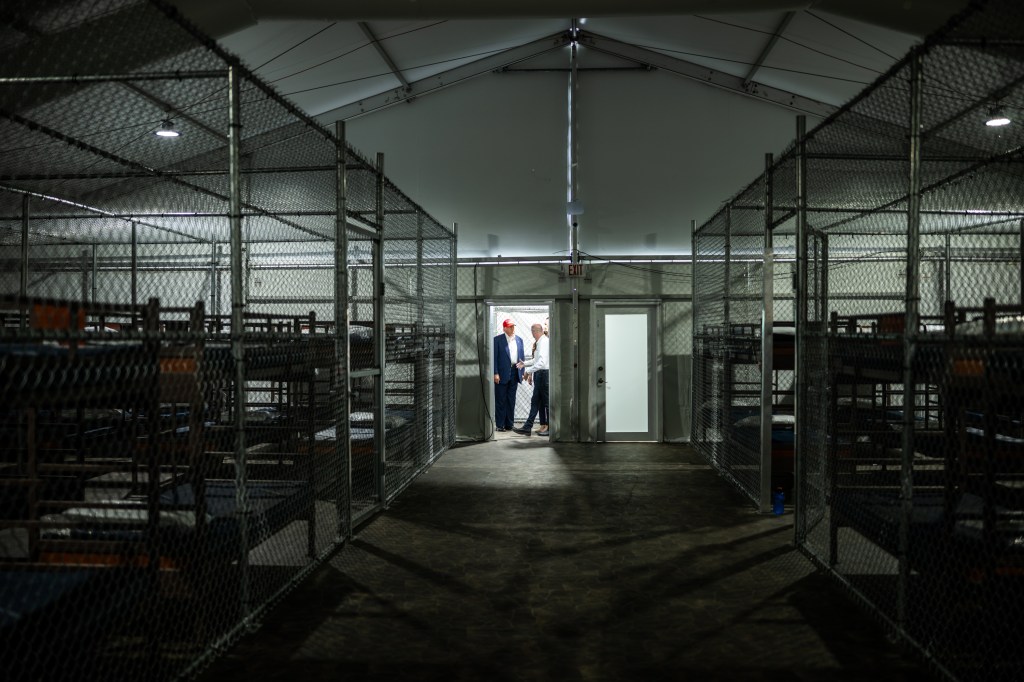
In Alcatraz, there is no natural light but rather a bright artificial light constantly on. The air-conditioning is fouled by the constantly running generators and causes many to become ill. Detainees are made to wear disposable uniforms which they were frequently ordered to remove and throw away. They are housed in large tents. Within the tents are chain-linked fence separations. Within each of these are 16 bunk beds, 32 people, and three toilets. There is no privacy. According to Roberto, there are 3 square meters in the toilet area. He calculated there were a total of 156 inmates in the pavilion that housed his chain-linked fenced-in parcel.There are two telephones between 32 people, which causes frequent quarrels.
Detainees’ routine starts with a 4 a.m. wake-up by the guards before they are moved to the dining area. Ninety percent of the guards are Afro-American non-Spanish speakers. Guards are intentionally loud and rude with the inmates. Inmates are forced to keep their gaze down. There is no television nor any commissary to buy anything. Prisoners are counted five times daily.
The detainees’ diet for breakfast is bread, eggs from powder, yellow cheese, pancakes, and Tang. At night, they are typically served rice, a vegetable, and some protein (breaded chicken).
Prisoners are given five minutes to eat. One Cuban refused to eat as fast as the guards demanded. The guard grabbed him and when five inmates protested, they were punished by being sent to the “hole” for several days, where they are sleep deprived. Its function is to break you.

When someone became desperately mentally ill, as some detainees suffered from drug addiction or alcoholism, they were taken to the doctor. Depressed inmates are moved to a different containment area. One Brazilian faked being crazy. He was drugged and constantly slept after that. Another individual was drugged with pills and later committed suicide with a bedsheet under questionable circumstances.
Roberto was held 90 days without charges. Because this is a private facility, Roberto surmised that the prison’s purpose is to rack up unnecessary expenses to generate income for the corporation by waste, shuffling detainees from cell to cell, from prison to prison.
On December 28, Roberto was placed on one of three buses, among 180 others, to drive 1.5 hours from Alcatraz to MIA to Jacksonville then to TX where they picked up 40 more individuals and then continued on to Louisiana.
The facility in LA is different, more professional. The staff are largely women. Detainees have access to phones, a commissary. Some request appointments for pursuing their cases. The rooms are larger; they have access to TV, sodas. Every three days they can take showers versus in Alcatraz where one would go five days without bathing. They have access to fields to play soccer. Their clothing is changed repeatedly and thrown away, not washed. They have access to computers to communicate with their families.
In LA, the detainees are separated: Latinos, Africans, detainees from Slavic countries, Muslims.
One day, they called Roberto along with 50 other Colombians and 20 Brazilians to board buses. They drove them to the airport and boarded them on a Boeing aircraft. One hundred and eighty Colombians were chained at the waist, wrists, and ankles. They had their Colombian IDs confiscated as well as their passports.
Roberto’s sister called the Colombian Embassy and was told that the embassy could not help Roberto. Cubans were flown to Belize but then returned to the U.S. and resent to Alcatraz. They cannot be returned to Cuba.
Roberto is in Colombia again and trying to put his life together again. He thinks about those he left behind, especially those who are being held while their families are outside and unable to see each other or help one another. He recently heard that some had their attorneys petition for Habeas Corpus with some effect. It all seems surreal.
###
The Revolutionist is 100% volunteer run and subscriber funded. We do not sell our soul for advertising dollars, nor do we prostrate ourselves for grants from the non-profit industrial complex. We are community media. Join the community! Subscribe today at whatever rate you can and get a hard copy of The Revolutionist in your mailbox. Subscribing subsidizes free distribution copies.


 The Revolutionist