
By Matilda Engaged
When democracy is under pressure, speaking out matters. But protest is not always simple. It takes time, energy, and often money. Even making signs or printed materials can become a barrier. Cyanotype offers a practical, affordable way for people to create and share their own protest imagery without relying on commercial printers or expensive equipment.
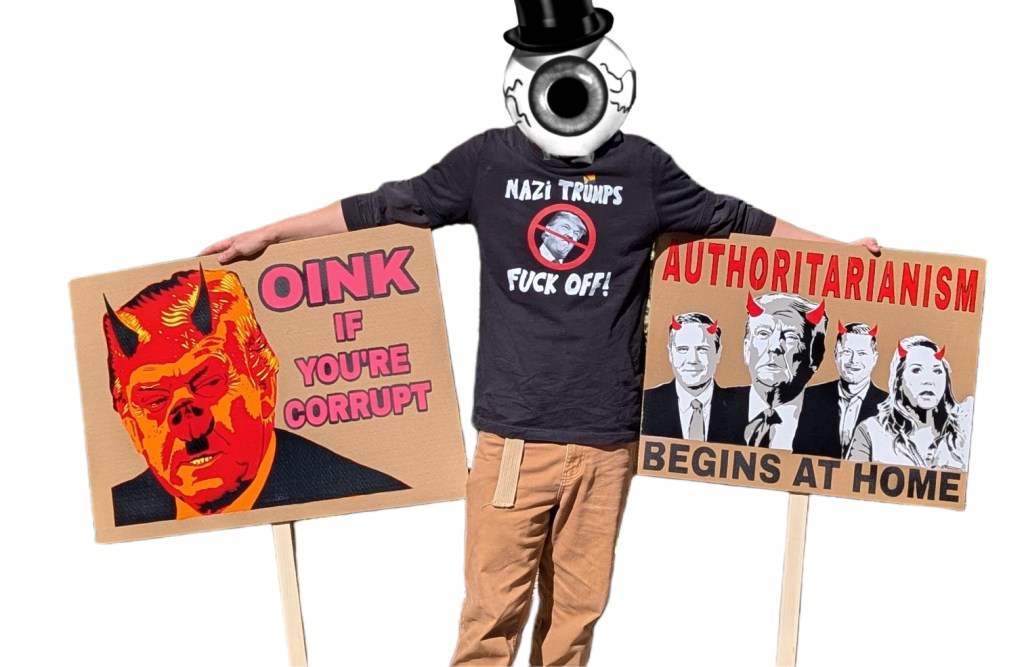
Printmaking has always been connected to political change because it allows images to be reproduced and shared widely. Before social media, television, and even widespread literacy, printed images were one of the fastest ways to spread ideas. A powerful image could be posted in public spaces, passed from hand to hand, or reprinted in newspapers. It helped people understand what was happening and decide how they felt about it.
During the American Revolution, printmakers used engravings and woodcuts to challenge British rule. Paul Revere’s engraving of the Boston Massacre and Benjamin Franklin’s “Join, or Die” cartoon did more than record events. They shaped public opinion. The images were clear and emotional, and they were easy to reproduce. Political ideas became something people could see.
Printmaking continued to play that role in the 20th century. In Germany after World War I, artists used prints to show the physical and emotional damage caused by war and nationalism. Instead of heroic scenes, they focused on injury, grief, and everyday suffering. In China and Mexico, artists created prints that responded to poverty, labor struggles, and foreign control. These works were often made quickly and cheaply so they could reach working people, not just gallery audiences.
What makes printmaking powerful is not only what it shows but how it functions. Prints can be produced outside official institutions and shared widely. Making something by hand and creating multiple copies becomes a way to push back against centralized control. The process itself carries meaning.
Cyanotype belongs in this tradition. Invented in 1842 by John Herschel and later popularized by Anna Atkins, cyanotype is one of the earliest photographic processes. It uses sunlight and iron-based chemicals to create deep blue images. The process is simple and physical. It captures light, time, and the direct presence of objects placed on the surface.
Unlike many printmaking techniques, cyanotype does not require a press or specialized studio. You coat paper or fabric with a light sensitive solution, place objects or stencils on top, and expose the surface to sunlight. After rinsing with water, the exposed areas turn blue while the covered areas remain light. The finished print often shows brush marks, textures, and subtle variations that make each piece feel immediate and personal.
Cyanotype is also affordable. The chemicals are inexpensive, sunlight is free, and no darkroom is needed. Because the process is accessible, clear instructions are widely available online. Anyone can learn it and begin experimenting right away.
Basic Cyanotype Directions
Cyanotype requires very little equipment. The two chemicals used, ferric ammonium citrate and potassium ferricyanide, are typically sold together and are easy to find at art supply stores or online. Mix equal parts of each solution, but only what you plan to use immediately. Work in dim light to prevent early exposure.
Brush the mixed solution evenly onto paper or fabric. Let it dry completely in a dark space. Once dry, arrange objects, stencils, or transparent images on the surface. Flat objects create the sharpest results. If needed, place a sheet of glass or acrylic on top to hold everything in place.
Expose the piece to direct sunlight or a UV light source. Depending on the strength of the light, exposure usually takes between five and twenty minutes. The exposed areas will shift to a muted gray-green color. After exposure, rinse the print in cool water until it stops releasing excess color. As it dries, the image will deepen into its final blue.
Cyanotype encourages experimentation. Overlap shapes. Layer text. Let brushstrokes remain visible. Try different papers or fabrics. Because the materials are affordable and the process is simple, you can experiment freely and develop your own visual language.
Make prints. Share them. Let them speak.
###
The Revolutionist is 100% volunteer run and subscriber funded. We do not sell our soul for advertising dollars, nor do we prostrate ourselves for grants from the non-profit industrial complex. We are community media. Join the community! Subscribe today at whatever rate you can and get a hard copy of The Revolutionist in your mailbox. Subscribing subsidizes free distribution copies.


 The Revolutionist